

HubSpot has spent 2026 turning Breeze from a set of AI features into the operating layer of the entire customer platform. At the Spring 2026 Spotlight, HubSpot shipped over 100 updates built around what it calls Growth Context — the idea that AI agents perform reliably only when they know your customers, your data, and how your team works. If you run marketing or revenue operations on HubSpot, the agents are no longer optional to understand.
Here’s the short answer up front: three Breeze AI agents are generally available today — Customer Agent, Prospecting Agent, and Data Agent — with Company Research Agent and Customer Health Agent in beta. As of April 14, 2026, Customer Agent and Prospecting Agent are priced on outcomes ($0.50 per resolved conversation and $1 per recommended lead), and as of July 2026, Prospecting Agent is available to every paid HubSpot account. The agents are genuinely useful — and they still need governance, QA, and a rollout plan before you trust them in production.
This guide covers what each agent does, where it breaks, what it costs, and how to QA it — based on HubSpot’s official announcements, product documentation, and third-party field reporting.
DOWNLOAD THE FULL SLIDE DECK HERE
What Are HubSpot Breeze AI Agents?
Breeze AI agents are purpose-built AI workers inside HubSpot’s Smart CRM that complete go-to-market tasks — resolving support conversations, qualifying and contacting prospects, and maintaining CRM data quality — using your company’s own customer data and business context rather than generic AI output.
The distinction HubSpot draws is between data and context: data is what happened, context is why. Because Breeze agents sit inside the Smart CRM, they read the full relationship history — emails, notes, deal activity, lifecycle stage, past tickets — before acting. That context is also HubSpot’s justification for pricing two of the agents on outcomes instead of usage: the company is confident enough in agent performance to charge only when the task completes.
Breeze also extends beyond the agents themselves. Breeze Assistant is the conversational copilot (now trained on HubSpot’s Loop Marketing playbook), and Breeze Projects is a shared AI workspace where teams collaborate with AI using file uploads and @mentions of CRM records. In July 2026, Breeze expanded into global search, email composition, assignment notifications, mobile meeting prep, and a Microsoft 365 Copilot integration.
Which Breeze Agents Are Available Right Now?
1. Customer Agent: Resolve Support Conversations Around the Clock
Customer Agent is an AI support rep that resolves routine customer conversations across chat and — new in 2026 — email, drawing on your knowledge base and full customer relationship history, and escalating to humans when it can’t resolve.
HubSpot reports Customer Agent resolves 70% of conversations on average, with top teams reaching 90%, and that teams using it alongside Help Desk see 50% more tickets resolved with 29% faster resolution. More than 8,000 customers have activated it.
- Best use cases: deflecting high-volume routine questions (pricing, how-to, account status), off-hours coverage, multi-brand support desks, and email queues — its highest-traffic channel since the Spring 2026 update
- Granular control: tone and style guidelines, channel-specific settings, working hours, percentage rollouts, and deploy-via-workflows for targeting specific ticket types
- Reply recommendations mode drafts responses for human review before anything reaches a customer — the right starting point for regulated industries
Key limitations: it can only answer from content you’ve given it — third-party testing notes it references HubSpot-hosted knowledge content, so an outdated or thin knowledge base means wrong or deflected answers. It requires a Service Hub Pro or Enterprise seat underneath, so the $0.50 per resolution sits on top of seat costs. And “resolved” is HubSpot’s billing trigger — long email threads and multi-issue conversations deserve monitoring so you understand exactly what you’re paying for.
2. Prospecting Agent: Research, Qualify, and Draft Outreach at Scale
Prospecting Agent handles the full prospecting lifecycle: it monitors buying signals, identifies complete buying committees, and drafts personalized outreach that reps review and approve before sending. As of July 2026 it’s available to every paid HubSpot customer, priced at $1 per recommended lead with a 28-day free trial.
- Signal monitoring: watches job postings, funding rounds, and technology adoption to surface accounts ready to buy — including newly discovered in-market companies
- Buying committee discovery: finds contacts matching your target personas and fills gaps with new contacts from connected third-party data providers
- Outreach drafting: writes personalized emails informed by signals and CRM history; HubSpot reports early users seeing response rates at 2x industry benchmark
Key limitations: every recommended lead costs 100 credits whether or not it converts, so a loosely-defined ICP burns budget fast. Draft quality depends directly on your CRM data quality — bad lifecycle data in, generic outreach out. And rep review isn’t optional in practice: this is your brand in a prospect’s inbox.
3. Data Agent: Keep the CRM Clean While You Sleep
Data Agent is the operations-facing agent, positioned to maintain CRM data quality — deduplication, formatting, and enrichment-style cleanup — as an ongoing background function rather than a quarterly project.
For marketing operations teams this is quietly the most strategic of the three: routing, scoring, segmentation, and attribution all sit downstream of data quality. Treat its changes like any data transformation — review its proposed actions before letting it run wide, and monitor merge logic against your own dedupe rules.
What’s in Beta and What’s Coming?
- Company Research Agent (beta): account research summaries built from CRM context plus external signals
- Customer Health Agent (beta): monitors account health signals to flag churn risk and expansion opportunities
- Smart Deal Progression (new at Spring Spotlight): after every sales call, analyzes the transcript alongside full deal history to suggest CRM updates, draft the follow-up email, and surface action items
- Breeze Projects: a shared AI workspace with direct file uploads, @mentions of CRM records, permission levels, and templates for prospecting and meeting prep
Smart teams are preparing the same way they would for any platform shift: documenting ICPs and personas, cleaning lifecycle and scoring data, and baselining KPIs so agent-driven results can actually be measured against something.
How Much Do Breeze Agents Cost?
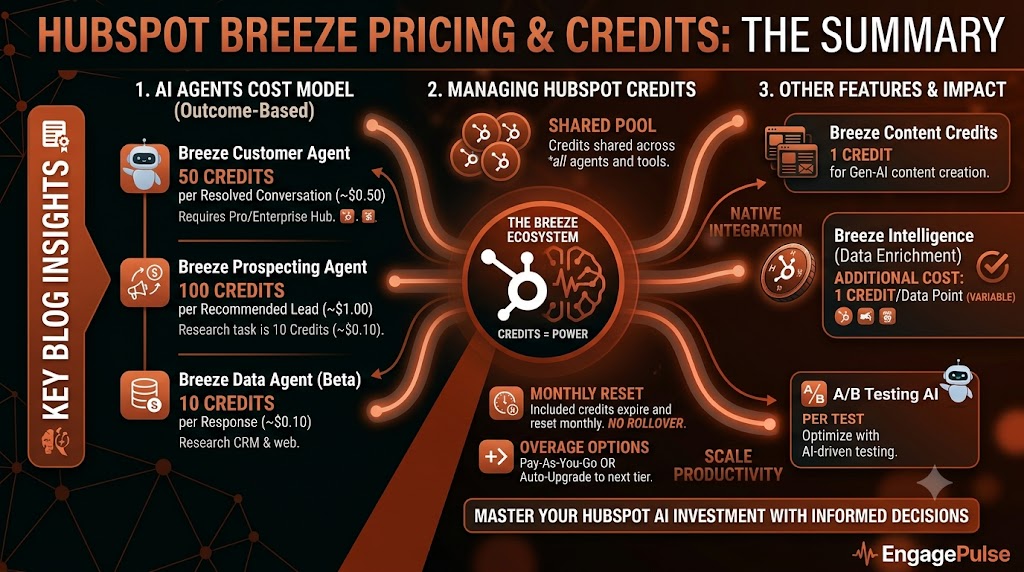
Since April 14, 2026, Customer Agent costs $0.50 per resolved conversation (50 HubSpot Credits) and Prospecting Agent costs $1 per recommended lead (100 credits) — you pay when the task completes, not per attempt. Credits run $10 per 1,000, with allowances included by tier (500 on Starter, 3,000 on Professional, 5,000 on Enterprise). Both agents require Pro or Enterprise and include 28-day free trials.
The headline rates are competitive, but the real math — credit burn at volume, seat costs underneath, and the definition of “resolved” — deserves its own analysis. We’ve broken down the full cost model, with worked scenarios, in our companion guide: HubSpot Credits Explained: What Breeze AI Agents Actually Cost Under Outcome-Based Pricing.
What Are the Biggest Limitations of Breeze Agents?
- Context quality is the ceiling. Every agent inherits your CRM’s data quality. Dirty lifecycle stages, stale contacts, and thin knowledge bases translate directly into wrong answers and wasted credits.
- Outcome pricing needs monitoring. “Resolved” and “recommended” are billing triggers defined by HubSpot. Most teams pay less than under the old model — but high-volume support desks and loose ICPs can quietly spend more.
- Seat costs sit underneath. Agent pricing is additive to Service Hub / Sales Hub Pro or Enterprise seats. Model total cost of ownership, not the per-outcome rate.
- Beta agents are beta. Company Research and Customer Health behavior will change. Don’t build processes on them yet.
- Human review is still the control. Outreach drafts, data merges, and customer replies all offer approval gates. Teams that rubber-stamp them are outsourcing their brand and data integrity to a model.
How Do You QA Breeze Agents Before Trusting Them?
The safest rollout pattern is: start in review mode, roll out by percentage, seed known tests, and verify agent claims against ground truth before expanding scope. Here’s the playbook we use:
- Start in reply-recommendation / review mode. Let Customer Agent draft and humans send for the first two weeks. Measure accuracy before granting autonomy.
- Use percentage rollouts. HubSpot supports rolling Customer Agent out to a fraction of conversations — start at 10-20%, compare CSAT and resolution quality against the human baseline.
- Seed known defects. File test tickets with known answers, ambiguous asks, and out-of-scope questions. Measure what the agent resolves, escalates, and gets wrong.
- Audit the knowledge base first. Customer Agent is only as accurate as the content behind it. Fix the top-20 articles before activation, not after the first bad answer.
- Review every Prospecting Agent draft for the first month. Check persona match, signal accuracy, and tone against your brand standards before approving sends.
- Track credit burn weekly. Reconcile resolutions and recommended leads against outcomes in your pipeline. False “resolutions” and junk leads are QA findings — feed them back.
Governance and Data Handling
Breeze agents operate inside HubSpot’s existing permission model, and actions are reviewable in the tools where they run. Before activation, your security and legal teams should review HubSpot’s current AI terms and data documentation — confirm how conversation data is processed, whether any data is used for model improvement under your agreement, and how percentage rollouts and approval gates map to your compliance requirements. Put the agents’ scope in writing (which channels, which ticket types, which segments) and treat expansions as change requests, not toggles.
Frequently Asked Questions
What is HubSpot Breeze?
Breeze is HubSpot’s AI layer — a family of AI agents (Customer, Prospecting, Data, and more in beta), the Breeze Assistant copilot, and embedded AI features across the Smart CRM that automate go-to-market work using your business’s own context.
Which Breeze agents are generally available in 2026?
Customer Agent, Prospecting Agent, and Data Agent are generally available. Company Research Agent and Customer Health Agent are in beta. Prospecting Agent became available to all paid HubSpot customers in July 2026.
How much does Breeze Customer Agent cost?
$0.50 per resolved conversation, billed as 50 HubSpot Credits, on top of a Service Hub Pro or Enterprise subscription. It moved from $1.00 per conversation to outcome-based pricing on April 14, 2026, and includes a 28-day free trial.
How much does Breeze Prospecting Agent cost?
$1.00 per lead recommended for outreach, billed as 100 HubSpot Credits. It previously ran on a recurring monthly charge per enrolled contact; early-access users who paid nothing per lead now pay per recommendation.
Do Breeze agents work on HubSpot Starter plans?
Customer Agent and Prospecting Agent require Pro or Enterprise. Starter tiers include a 500-credit monthly allowance for Breeze features, but the flagship agents are gated to higher tiers.
Can Breeze agents send emails without human approval?
Prospecting Agent drafts outreach for rep review and approval before sending. Customer Agent can resolve conversations autonomously, but supports reply-recommendation mode, percentage rollouts, working hours, and channel restrictions so teams control how much autonomy it gets.
Will Breeze agents replace marketing operations roles?
No — they shift the work. The execution layer (ticket deflection, list hygiene, outreach drafting) gets automated; the judgment layer (governance, QA, data strategy, and verifying agent output) becomes more valuable. Teams that learn to direct and audit agents will outperform teams that ignore them.
Sources
- HubSpot Spring 2026 Spotlight announcement — HubSpot
- Customer Agent and Prospecting Agent outcome-based pricing — HubSpot
- Breeze AI product page — HubSpot
- HubSpot moves to outcome-based pricing for some Breeze AI agents — MarTech
- HubSpot July 2026 product updates — Vantage Point
- HubSpot Breeze pricing change analysis — Resolve247

Leave a Reply