

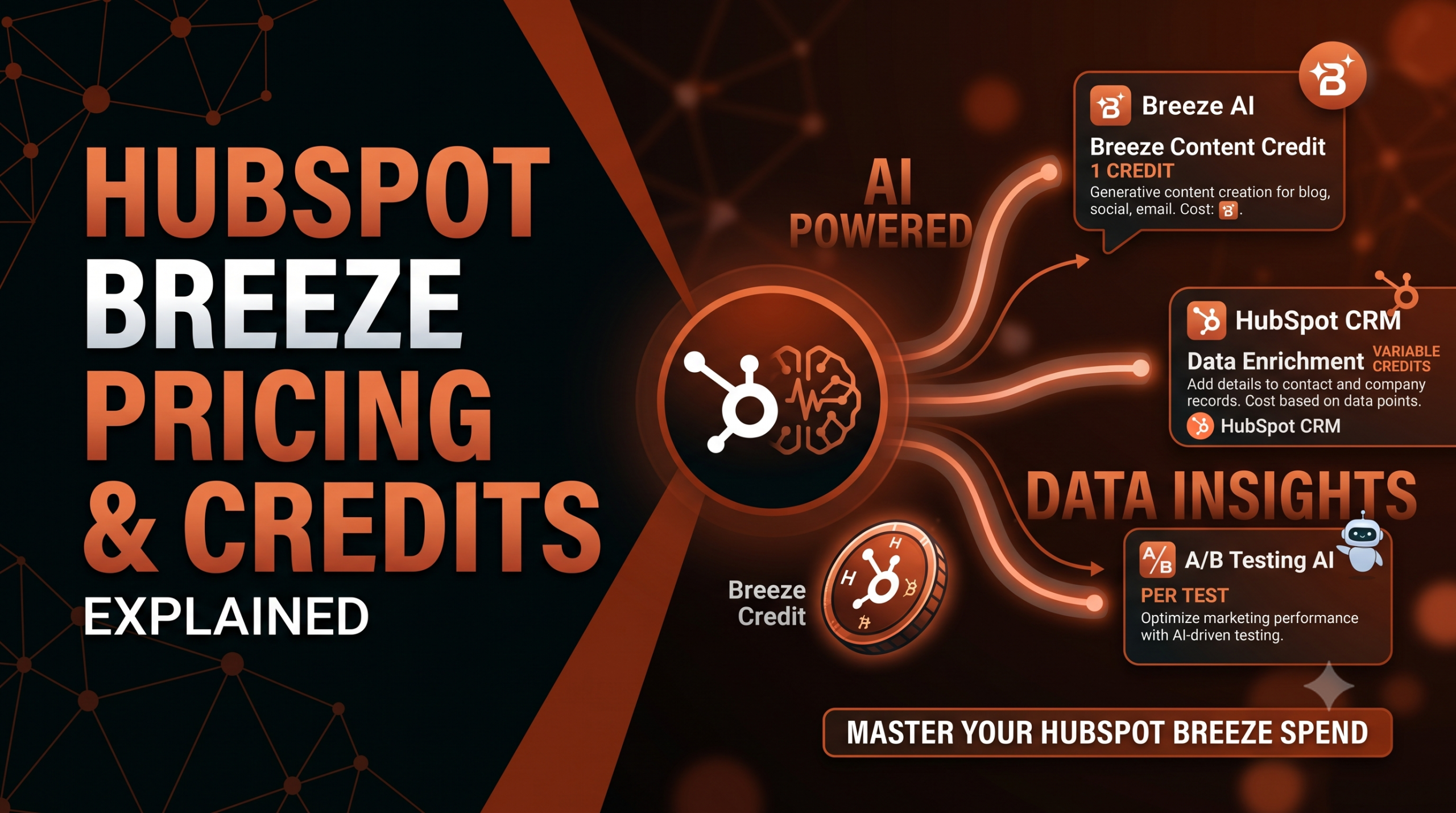
On April 14, 2026, HubSpot changed how two of its flagship Breeze AI agents are billed — and if you activated Customer Agent or Prospecting Agent before that date, your invoice math changed with it. The headline is friendly: you now pay only when the agent completes its task. The details reward a closer read.
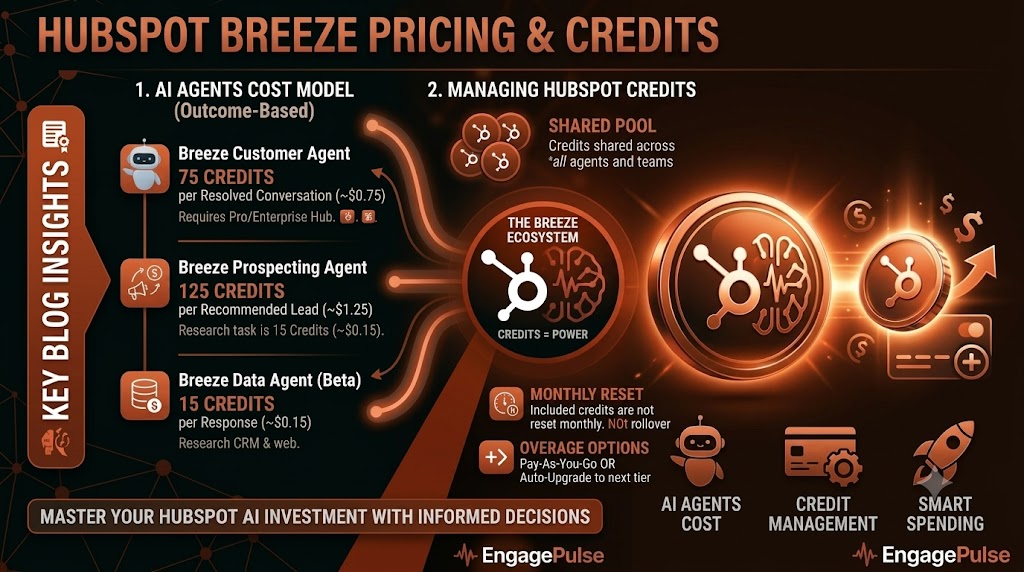
Here’s the short answer up front: Breeze Customer Agent now costs $0.50 per resolved conversation (50 HubSpot Credits) instead of $1.00 per conversation, and Prospecting Agent moved from a recurring monthly charge per enrolled contact to $1.00 per lead recommended for outreach (100 credits). Credits cost $10 per 1,000, and your plan includes a monthly allowance: 500 credits on Starter, 3,000 on Professional, 5,000 on Enterprise. For most teams the change is a price cut — but high-volume support desks, loose ICP definitions, and the definition of “resolved” can quietly move the number the other way.
This guide walks through the new model, the fine print, and the worked math you need before taking a budget to your leadership team.
DOWNLOAD THE FULL SLIDE DECK HERE
What Changed on April 14, 2026?
HubSpot moved Customer Agent and Prospecting Agent from usage-based to outcome-based pricing: you’re billed when a conversation is resolved or a lead is recommended, not when the agent merely attempts the work.
- Customer Agent: from $1.00 per conversation to $0.50 per resolved conversation (50 credits). HubSpot reports the agent resolves 65-70% of conversations on average across 8,000+ activated customers.
- Prospecting Agent: from a recurring monthly charge for every enrolled contact to $1.00 per lead recommended for outreach (100 credits). Early-access users who previously paid nothing per lead now pay per recommendation.
- Both agents require Pro or Enterprise plans and now include 28-day free trials. Billing runs through HubSpot Credits.
HubSpot’s framing, from Chief Customer Officer Jon Dick: “Outcome-based pricing removes that risk. You pay when it works, full stop.” The strategic logic is sound — HubSpot is betting its context advantage (agents that read your full CRM history) produces consistent enough outcomes to bill on results. It’s also a signal of where the entire AI software market is heading.
How Do HubSpot Credits Work?
HubSpot Credits are the platform’s universal currency for AI usage: you buy them at $10 per 1,000 credits, agents consume them per outcome, and every plan tier includes a monthly allowance.
- Starter: 500 credits/month included — enough for ~10 resolved conversations or 5 recommended leads (though the flagship agents themselves require Pro+)
- Professional: 3,000 credits/month included — ~60 resolutions or 30 recommended leads
- Enterprise: 5,000 credits/month included — ~100 resolutions or 50 recommended leads
Two things to note. First, the included allowances did not change with the April pricing update — but because Customer Agent now consumes 50 credits per resolution instead of 100 per conversation, the same allowance stretches roughly twice as far. Second, allowances are shared across Breeze features, so heavy use of one agent eats the budget available to everything else.
What Does Customer Agent Actually Cost at Volume?
The realistic monthly cost is: (conversations handled × resolution rate × 50 credits) minus your included allowance, at $10 per 1,000 credits — on top of the Service Hub Pro or Enterprise seats underneath.
Worked example on Professional (3,000 credits included):
- 500 conversations/month × 70% resolution rate = 350 resolutions × 50 credits = 17,500 credits
- 17,500 − 3,000 included = 14,500 credits to purchase ≈ $145/month in agent costs
- At 2,000 conversations/month: 1,400 resolutions = 70,000 credits ≈ $670/month after allowance
Compare that to the loaded cost of support headcount and the math is usually compelling — but it’s a real line item that scales with ticket volume, and it sits on top of seat costs, not instead of them. Third-party analyses have flagged scenarios (long-running email threads, multi-issue tickets) where per-resolution billing is less favorable than it first appears, so monitor your first two billing cycles closely.
What Does Prospecting Agent Actually Cost at Volume?
Prospecting Agent charges 100 credits ($1) for every lead it recommends for outreach — regardless of whether that lead replies, converts, or was worth recommending.
That makes your ICP definition the biggest cost lever you control:
- A tightly-defined ICP recommending 200 leads/month ≈ $200 in credits (minus allowance) — trivial against one closed deal
- A loose ICP recommending 2,000 marginal leads/month ≈ $2,000 in credits for pipeline your reps may ignore
- HubSpot reports early users seeing outreach response rates at 2x industry benchmark — but that stat reflects teams whose targeting and CRM data were already in order
The agent is only as expensive as your targeting is sloppy. Before activating it, tighten persona definitions, suppress existing customers and open deals, and decide who reviews recommendations weekly.
The Fine Print: Four Things to Check Before You Budget
- The definition of “resolved.” Resolution is HubSpot’s billing trigger. Understand how re-opened conversations, multi-issue threads, and customer silence are counted before you forecast from the $0.50 headline.
- Seats underneath. Customer Agent needs Service Hub Pro/Enterprise; Prospecting Agent needs Sales Hub Pro/Enterprise (from $90-100/seat/month). Model total cost of ownership.
- Shared credit pools. Agents, Breeze features, and future AI capabilities draw from the same credit balance. Set a monthly credit budget per team, not per portal.
- Trial data is your forecast. Both agents include 28-day free trials. Run the trial at realistic volume, export the outcome counts, and build your budget from measured resolution and recommendation rates — not from HubSpot’s averages.
How to Take This to Your Leadership Team
The budget conversation is straightforward if you frame it as cost-per-outcome against the alternative: loaded cost of headcount for support, and cost-per-qualified-lead from existing channels for prospecting.
- Baseline current state: conversations per month, cost per resolution with humans, cost per qualified lead from current channels
- Run the 28-day trials at realistic volume and capture actual resolution/recommendation rates
- Model three scenarios (conservative, expected, aggressive volume) using the credit math above
- Set guardrails: monthly credit budget, weekly burn monitoring, and a defined owner for reviewing agent outcomes
- Present it as a pilot with exit criteria, not a platform commitment
For the full picture of what each agent does — capabilities, limitations, and the QA playbook before you trust them in production — see our companion guide: HubSpot Breeze AI Agents: Use Cases, Limitations, and How to QA Them.
Frequently Asked Questions
What is outcome-based pricing in HubSpot?
Outcome-based pricing means you pay when a Breeze agent completes its assigned task — a resolved support conversation or a lead recommended for outreach — rather than paying per attempt, per conversation, or per enrolled contact. It took effect April 14, 2026 for Customer Agent and Prospecting Agent.
How much do HubSpot Credits cost?
$10 per 1,000 credits. Customer Agent consumes 50 credits per resolved conversation ($0.50); Prospecting Agent consumes 100 credits per recommended lead ($1.00). Plans include monthly allowances: 500 (Starter), 3,000 (Professional), 5,000 (Enterprise).
Did Breeze get cheaper in 2026?
For most teams, yes — Customer Agent’s effective rate halved and you no longer pay for unresolved conversations. But Prospecting Agent went from free (for early-access users) to $1 per recommended lead, and high-volume portals can still see substantial credit bills. Run the trial and measure.
Do unused HubSpot credits roll over?
Check your current HubSpot terms — credit handling and rollover policies are defined in your subscription agreement and have been a moving target as the credits system matures. Build budgets assuming monthly allowances are use-it-or-lose-it until confirmed otherwise.
Can I cap how much Breeze agents spend?
You control spend through rollout controls rather than hard caps: percentage rollouts, channel restrictions, working hours, and ticket-type targeting for Customer Agent; ICP definitions and enrollment criteria for Prospecting Agent. Monitor credit consumption weekly in your billing settings.
Is Prospecting Agent worth $1 per lead?
If your ICP is tight and your CRM data is clean, $1 per researched, qualified, outreach-ready lead is far below the cost of SDR research time. If your targeting is loose, you’ll pay for recommendations your team ignores. The variable isn’t the price — it’s your data discipline.
Sources
- Customer Agent and Prospecting Agent: Now you pay when the task is complete — HubSpot
- HubSpot Spring 2026 Spotlight announcement — HubSpot
- HubSpot moves to outcome-based pricing for some Breeze AI agents — MarTech
- HubSpot Breeze pricing change: now outcome-based — Resolve247
- Prospecting Agent credits pricing guide — Vantage Point
- Breeze pricing and packaging: what changed in Spring 2026 — Fast Slow Motion

Leave a Reply