

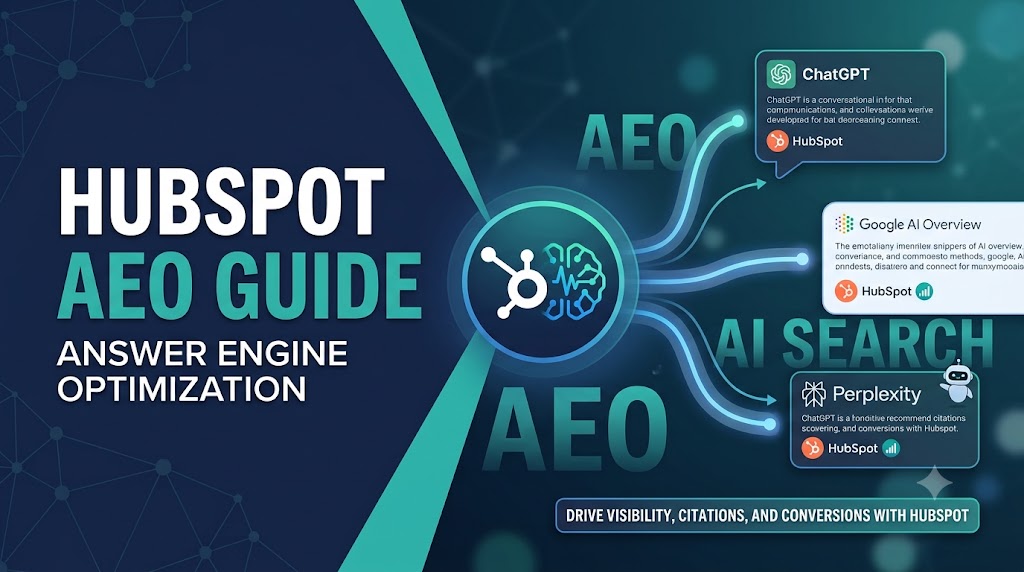
The most uncomfortable stat HubSpot published this year: organic traffic for its customers is down 27% year-over-year, while AI referral traffic across the industry has roughly tripled. Buyers haven’t stopped researching — they’ve moved the research into ChatGPT, Gemini, and Perplexity, and they arrive at your site (if they arrive at all) already convinced. That’s the problem HubSpot AEO exists to solve.
Here’s the short answer up front: HubSpot AEO (Answer Engine Optimization) is a new tool, launched at the Spring 2026 Spotlight, that tracks and improves how your brand appears in AI answer engines. It’s included with Marketing Hub Pro and Enterprise, or available standalone for $50/month with no HubSpot plan required. Both versions include citation analysis, competitor benchmarking, and prioritized recommendations — and the embedded Pro/Enterprise version uses your own customer data to suggest the prompts real buyers are likely typing into LLMs.
This guide covers what AEO actually is, what HubSpot’s tool does, where it fits alongside SEO, and a 90-day plan to take to your team. (AEO was one of two headline launches at the Spring Spotlight — the other was the expansion of Breeze AI agents, covered in our companion guide: HubSpot Breeze AI Agents: Use Cases, Limitations, and How to QA Them.)
DOWNLOAD THE FULL SLIDE DECK HERE
What Is AEO (Answer Engine Optimization)?
AEO is the practice of making your brand visible, accurately represented, and frequently cited in AI-generated answers — the responses users get from ChatGPT, Gemini, Perplexity, and AI Overviews — rather than in ranked lists of blue links.
The mechanics differ from SEO in ways that matter operationally. Search engines rank pages; answer engines synthesize answers from sources they trust and cite a handful of them. Winning means being one of the cited sources — which rewards clear, authoritative, well-structured content, third-party validation (reviews, comparisons, community mentions), and consistent entity information across the web. And the payoff profile is different too: AI referral traffic is smaller in volume but converts at a higher rate, because the answer engine has already done the qualifying.
What Does HubSpot AEO Actually Do?
HubSpot AEO monitors how answer engines talk about your brand, benchmarks you against competitors, and produces a prioritized list of actions to improve your AI visibility. Three capabilities do the work:
- Citation analysis: tracks when and where your brand is cited in AI answers, and which sources the engines are pulling from — so you know what content is earning citations and what’s invisible
- Competitor benchmarking: shows how your AI visibility compares to named competitors on the prompts that matter in your category
- Prioritized recommendations: converts the gap analysis into a ranked action list instead of a dashboard you have to interpret yourself
The differentiator sits in the embedded version: for Marketing Hub Pro and Enterprise customers, HubSpot AEO uses your own CRM and customer data to suggest the prompts real customers are likely to use in LLMs. Every other AEO tool on the market asks you to guess which prompts to track — and if you guess wrong, you optimize for questions nobody asks. HubSpot also ships two free entry points: the AEO Grader and the AI Search Sensor, both useful for a first read on where you stand.
How Much Does HubSpot AEO Cost?
Two options: included with Marketing Hub Pro or Enterprise, or standalone at $50/month with no HubSpot plan required. The standalone tier covers citation analysis, competitor benchmarking, and recommendations; the embedded version adds the customer-data-driven prompt suggestions. The tool is currently labeled beta, so expect the feature set to move quickly.
At $50/month standalone, this is priced to be a no-brainer line item — notably cheaper than most dedicated AEO/GEO monitoring tools, and low enough to justify on a single influenced deal for most B2B businesses.
AEO vs. SEO: Do You Still Need Both?
Yes — AEO extends SEO rather than replacing it. Answer engines cite sources that traditional search fundamentals make crawlable, credible, and clear. The work overlaps heavily: structured content, schema, entity consistency, and authoritative third-party mentions serve both. What changes is the measurement (citations and share-of-answer instead of rankings alone) and some of the content strategy:
- Answer-first formatting: lead sections with the direct answer, then elaborate — LLMs lift concise, self-contained explanations
- Question-shaped headings and genuine FAQ coverage that matches how buyers phrase prompts
- Comparison and alternatives content — answer engines lean on it heavily for “best X for Y” prompts
- Third-party presence: reviews, communities, and industry publications are citation sources you don’t control but can influence
A 90-Day HubSpot AEO Plan to Take to Your Team
- Weeks 1-2 — Baseline. Run HubSpot’s free AEO Grader, activate the tool, and capture your current citation footprint and competitor benchmark. Screenshot everything — this is your before picture.
- Weeks 3-4 — Prompt strategy. Review HubSpot’s data-driven prompt suggestions (or build a prompt list from sales call language and support tickets if you’re on standalone). Pick 20-30 prompts that map to revenue.
- Weeks 5-8 — Content sprint. Work the prioritized recommendations: restructure key pages answer-first, close FAQ gaps, publish or refresh comparison content targeting your top prompts.
- Weeks 9-12 — Authority pass. Address third-party citation gaps: review platforms, industry directories, community presence. Re-run the benchmark and report movement in citations and AI referral conversions — not just traffic.
What Are the Limitations?
- It’s a beta product. Capabilities, coverage, and pricing structure can shift. Don’t hard-wire it into reporting commitments yet.
- Answer engines are moving targets. Model updates change citation behavior overnight; treat week-over-week swings as noise and optimize for the quarter.
- Measurement is directional. AI referral attribution is young — engines strip or genericize referrer data inconsistently. Pair the tool’s citation tracking with conversion-quality metrics.
- The tool doesn’t write the content. Recommendations still land in someone’s backlog. AEO wins go to teams with a content operation that can execute — the tool just tells them where to aim.
Frequently Asked Questions
What is HubSpot AEO?
HubSpot AEO is an answer engine optimization tool launched at the Spring 2026 Spotlight. It tracks how your brand appears in AI answer engines like ChatGPT, Gemini, and Perplexity, benchmarks you against competitors, and produces prioritized recommendations to improve your AI visibility.
How much does HubSpot AEO cost?
It’s included with Marketing Hub Professional and Enterprise plans, or available as a standalone product for $50/month with no HubSpot plan required.
Is AEO the same as GEO or LLM SEO?
Effectively yes — AEO (answer engine optimization), GEO (generative engine optimization), and LLM SEO all describe optimizing for visibility in AI-generated answers. AEO is the label HubSpot has standardized on.
Does AEO replace SEO?
No. Answer engines cite sources that solid SEO fundamentals make crawlable and credible. AEO adds new measurement (citations, share-of-answer) and content patterns (answer-first structure, comparison coverage) on top of that foundation.
Why does AI traffic matter if it’s smaller than organic?
Because it converts better. Industry data shows LLM referral traffic converting at higher rates than traditional channels — the answer engine pre-qualifies the visitor before they ever reach your site. HubSpot’s own customers saw organic traffic fall 27% year-over-year while AI referrals tripled industry-wide.
How do I check my brand’s AI visibility for free?
HubSpot offers two free tools: the AEO Grader (a visibility audit) and the AI Search Sensor. They’re a reasonable first read before committing to ongoing tracking.
Who should own AEO — SEO, content, or PR?
Treat it as an extension of your organic/content function with PR support for third-party citations. The measurement lives with whoever owns organic reporting; the execution spans content (answer-first restructuring) and communications (reviews, mentions, directories).

Leave a Reply