

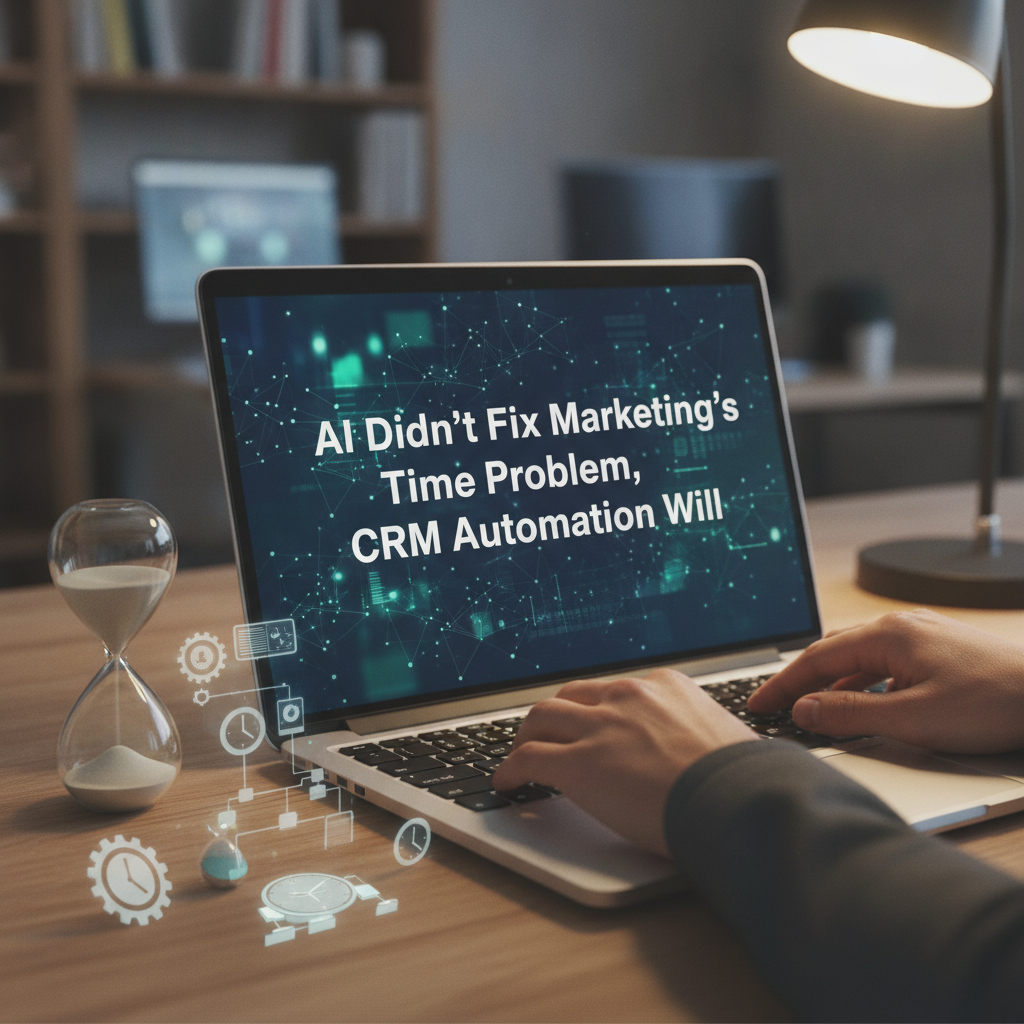
Why AI Still Hasn’t Fixed Marketing’s Time Problem — And What SaaS Leaders Should Do Instead
If you asked most CMOs and marketing directors in 2026 whether AI has given their teams more time back, you’d likely hear a frustrated laugh. Despite billions poured into AI-powered martech, a growing body of research — including a widely discussed analysis from Martech.org — points to an uncomfortable truth: AI has not solved marketing’s time problem. In many cases, it has made the problem worse.
For SaaS companies, this isn’t just an operational annoyance. Time lost to manual work, redundant approvals, and disconnected systems directly translates into slower pipeline velocity, missed trial conversions, and marketing teams that are perpetually stretched thin. If your organization runs on Marketo, HubSpot, or Salesforce, this article breaks down exactly why AI alone hasn’t delivered the productivity gains it promised — and how smarter CRM automation, not just smarter algorithms, is the real fix.
The Time Paradox: More AI Tools, Less Time Saved
Here’s the paradox every marketing leader is quietly grappling with: the average marketing stack in 2026 includes more AI-enabled tools than ever before, yet marketing teams report spending just as much — or more — time on manual, repetitive tasks as they did five years ago.
Why? Because AI tools are typically bolted onto existing workflows rather than replacing the broken processes underneath them. A generative AI tool might write your email copy in seconds, but if that copy still has to be manually uploaded into Marketo, mapped to the correct segment, approved by three stakeholders, and QA’d before sending, you haven’t saved meaningful time. You’ve just moved the bottleneck.
This is the core insight missing from most conversations about AI in martech: AI accelerates individual tasks, but it does not automatically fix the connective tissue between systems, teams, and approvals. That connective tissue — the CRM and marketing automation layer — is where the real time savings live.
Why AI Alone Can’t Solve the Time Crunch
1. AI Doesn’t Fix Fragmented Systems
Most SaaS marketing teams operate across a patchwork of tools: a CRM for sales data, a marketing automation platform for campaigns, a CMS for content, spreadsheets for reporting, and increasingly, standalone AI copilots for content generation. When these systems don’t talk to each other natively, AI output becomes just another manual input someone has to move, format, and reconcile.
2. AI Increases Output Volume, Not Workflow Efficiency
Generative AI is exceptional at producing more content, more variations, and more personalized messages faster than ever. But more output requires more review, more approval cycles, and more distribution logic. Without automated routing and approval workflows built into your CRM, AI-generated volume simply creates a new backlog.
3. Human Judgment Still Bottlenecks the Pipeline
AI can draft an email sequence, but someone still has to decide which segment receives it, when it triggers, and how it nests within the broader lifecycle journey. If that decision-making process isn’t automated at the CRM level — through lead scoring, behavioral triggers, and lifecycle stage logic — human review remains the rate-limiting step.
4. Most Teams Automate Tasks, Not Systems
This is the biggest misstep SaaS marketing teams make. They ask, “How can AI help me write this faster?” instead of asking, “How can this entire process run without me?” Task-level automation feels productive, but system-level automation is what actually returns hours to your team’s week.
The Real Fix: CRM-Native Automation, Not Just AI Add-Ons
Platforms like Marketo, HubSpot, and Salesforce were built to solve exactly the problem AI alone cannot: orchestrating multi-step, multi-team workflows without manual intervention. The companies seeing genuine time savings in 2026 aren’t the ones with the flashiest AI writing assistant — they’re the ones who have rebuilt their CRM automation architecture so AI-generated content and data flow directly into pre-built, trigger-based workflows.
Let’s break down what this looks like on each major platform.
Marketo: Fixing the Lead-to-Revenue Bottleneck
For SaaS companies with longer sales cycles and complex lead scoring models, Marketo remains a powerhouse — but only if its automation engine is fully utilized. Too many teams use Marketo primarily as an email-send tool, manually building campaigns for every segment variation.
- Smart Campaigns with dynamic content blocks eliminate the need to build separate emails for every persona or lifecycle stage.
- Behavioral scoring models automatically move leads through nurture tracks based on engagement, removing manual list segmentation.
- Revenue Cycle Modeler integrations with Salesforce ensure MQL-to-SQL handoffs happen instantly, not during a weekly sync meeting.
When AI-generated content is fed into these existing Marketo structures — rather than manually uploaded and triggered — the time savings compound rather than plateau.
HubSpot: Automating the Full SaaS Trial-to-Paid Journey
HubSpot has leaned heavily into AI features in recent releases, but the platform’s real strength for SaaS companies is workflow automation across marketing, sales, and customer success in a single system of record.
- Workflow-based lifecycle automation can move a free-trial user through onboarding emails, in-app nudges, and sales handoff without a single manual trigger.
- AI-assisted lead scoring combined with workflow branching means only genuinely sales-ready leads reach a rep’s inbox.
- Custom-coded actions and webhooks allow product usage data to trigger CRM updates automatically — critical for product-led SaaS motions.
The mistake many HubSpot users make is treating AI content tools and automation workflows as separate initiatives. When AI drafts content directly into a workflow’s action steps, the entire trial-to-paid journey can run with minimal human touch, freeing marketing teams to focus on strategy rather than execution.
Salesforce: Closing the Loop Between Marketing and Revenue
Salesforce, particularly with Marketing Cloud and Einstein AI, offers some of the most sophisticated automation capability in the industry — but complexity often means SaaS teams under-implement its full potential.
- Einstein-powered next-best-action recommendations reduce manual campaign planning by surfacing what to send, to whom, and when.
- Flow Builder automation can eliminate manual data entry between marketing campaigns and opportunity records.
- Journey Builder allows multi-channel sequences (email, SMS, in-app) to run without manual campaign-by-campaign setup.
For SaaS organizations with complex enterprise sales motions, connecting Salesforce automation directly to product usage data and AI-driven scoring models is where the real time reclamation happens — not in the AI tool itself, but in the workflow logic surrounding it.
A Framework for Reclaiming Marketing Time in 2026
If your team is drowning despite (or because of) your AI investments, here’s a practical framework to diagnose and fix the underlying automation gaps.
Step 1: Audit Where Time Actually Goes
Before adding another tool, map your current workflows end-to-end. Where do humans manually move data between systems? Where does content sit waiting for approval? Where do leads stall between marketing and sales? This audit almost always reveals that the time problem isn’t a content-creation problem — it’s a handoff problem.
Step 2: Consolidate Before You Automate
Tool sprawl is the silent killer of marketing efficiency. Every additional point solution — even AI-powered ones — adds another manual export/import step. Before automating, consolidate wherever possible around your core CRM (Marketo, HubSpot, or Salesforce) so automation has a single source of truth to work from.
Step 3: Automate Triggers, Not Just Tasks
Rather than automating individual tasks (writing an email, formatting a report), automate the triggers that initiate entire sequences: a trial sign-up, a pricing page visit, a support ticket resolution, a contract renewal date approaching. This is where CRM-native automation dramatically outperforms standalone AI tools.

Leave a Reply