

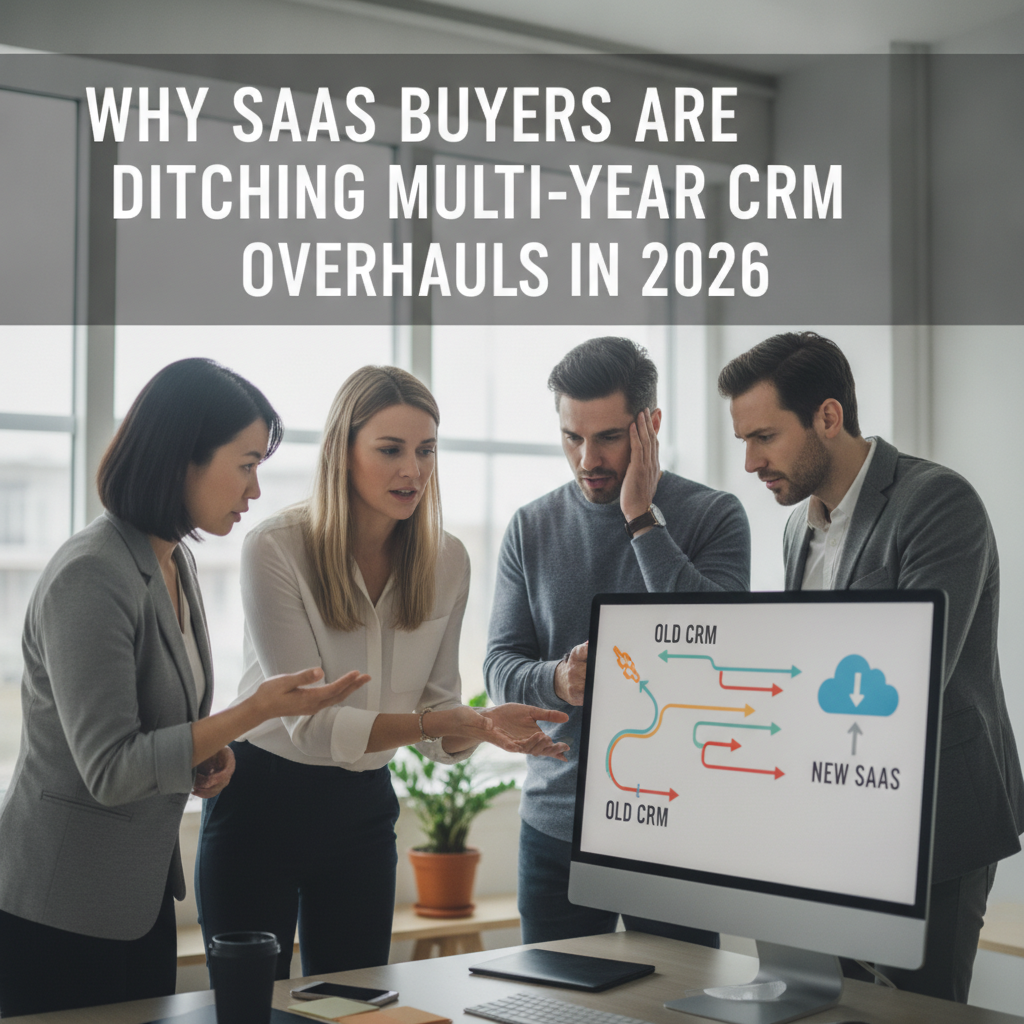
Why SaaS Buyers Are Rejecting Multi-Year CRM Overhauls in 2026 (And What Smart Marketing Teams Are Doing Instead)
If you’ve floated the idea of a full-scale CRM overhaul to your leadership team recently, you’ve probably noticed something: the enthusiasm just isn’t there anymore. CFOs are skeptical. Sales leaders are wary. Even your own marketing operations team is quietly dreading another 18-month migration project that promises the world and delivers a support ticket queue.
This isn’t a coincidence. A recent piece from MarTech.org nailed something that’s been building for years: buyers have simply lost patience with the “rip everything out and start over” approach to marketing technology. In 2026, the SaaS companies winning with their CRM stacks — whether that’s Marketo, HubSpot, or Salesforce — are the ones who’ve abandoned the multi-year overhaul mindset entirely in favor of something faster, leaner, and far less risky.
In this post, we’ll break down exactly why buyers have turned against the long-haul software transformation, what this shift means for SaaS marketing leaders specifically, and how you can build an automation roadmap that delivers value in weeks instead of years — without blowing up your existing CRM investment.
The Multi-Year Overhaul Was Never Built for SaaS Speed
Traditional enterprise software rollouts were designed in an era when technology moved slowly and business models stayed relatively static for years at a time. A three-year implementation timeline made sense when the underlying business wasn’t going to change dramatically in that window.
SaaS companies don’t operate that way. Your pricing model might shift twice this year. Your ideal customer profile could pivot after a single product launch. Your GTM motion might go from sales-led to product-led (or some hybrid) faster than a Salesforce migration can even reach its “discovery phase” sign-off.
This mismatch is exactly what MarTech.org is pointing to. Buyers aren’t rejecting powerful software — they’re rejecting the assumption that their business will hold still long enough to justify a multi-year commitment to a single, rigid implementation plan. And for SaaS leaders specifically, that mismatch is even more painful, because the entire value proposition of SaaS is agility.
Why CMOs, CEOs, and Marketing Directors Are Saying “No More”
Let’s get specific about what’s actually driving the pushback in boardrooms and budget meetings this year.
1. The ROI Timeline Doesn’t Match the Business Timeline
When a CFO asks “when will we see return on this CRM investment,” and the honest answer is “sometime in year two of a three-year rollout,” that conversation is over before it starts. SaaS companies are under constant pressure to prove marketing efficiency, and a multi-year payback period simply doesn’t survive budget scrutiny anymore.
2. Key Stakeholders Change Before the Project Finishes
The average tenure for a CMO or VP of Marketing continues to shrink. It’s common for the executive who greenlit a massive Marketo or Salesforce overhaul to be gone before the project reaches its halfway point. The next leader inherits a half-finished implementation with no ownership over the original vision — and often no appetite to finish it the way it was designed.
3. AI-Driven Martech Is Evolving Too Fast to Lock In
This is the big one for 2026. Predictive lead scoring, AI-assisted campaign orchestration, and generative content workflows inside HubSpot and Marketo are evolving on a quarterly cadence, not a yearly one. Locking your team into a rigid, multi-year technical architecture means you’re guaranteed to be running outdated automation logic by the time the “final phase” goes live.
4. Buyer Fatigue Is Real
Marketing and RevOps teams have lived through enough failed transformations to develop genuine skepticism toward big-bang implementations. They’ve seen the kickoff decks with the exciting roadmap slides, and they’ve also seen those same projects quietly get shelved 14 months later when priorities shift. Trust in the “big overhaul” pitch has eroded — and rightfully so.
What This Means for Your CRM and Marketing Automation Strategy
None of this means SaaS companies should stop investing in CRM sophistication. Marketo, HubSpot, and Salesforce remain the backbone of scalable marketing automation for a reason. What’s changing is how that investment should be structured.
Instead of a single sprawling overhaul, the companies winning in 2026 are adopting what we call a modular automation strategy — a series of smaller, independently valuable projects that compound over time rather than one giant bet that lives or dies together.
The Old Model vs. The New Model
- Old model: 18–36 month full-platform migration, single “go-live” date, all value realized at the end.
- New model: 4–8 week sprints, each targeting one automation outcome, value realized continuously.
This shift matters enormously for SaaS marketing leaders because it changes the entire risk profile of your martech investment. If a sprint underperforms, you’ve lost a few weeks and a modest budget — not a fiscal year and your credibility with the board.
Building a Phased CRM Automation Roadmap That Actually Works
So what does a modular approach actually look like in practice for a SaaS company running Marketo, HubSpot, or Salesforce? Here’s a framework we use with clients at EngagePulse.io.
Phase 1: Audit and Quick Wins (Weeks 1–4)
Before touching architecture, identify the automation gaps causing the most immediate pain — usually lead routing delays, broken lifecycle stage triggers, or manual reporting processes eating up hours every week. These quick wins build internal trust and generate early ROI proof points that justify continued investment.
Phase 2: Lifecycle and Lead Scoring Refinement (Weeks 5–10)
This is where you tighten up how Marketing Qualified Leads (MQLs) and Product Qualified Leads (PQLs) are scored and routed between Marketing, Sales, and Customer Success. For SaaS companies with product-led growth motions, this often means integrating in-app behavioral data into HubSpot or Marketo scoring models — a project that can be scoped and delivered in weeks, not quarters.
Phase 3: Cross-Platform Data Synchronization (Weeks 11–16)
Many SaaS companies run Salesforce for sales data and HubSpot or Marketo for marketing automation, and the sync between them is often held together with duct tape and outdated field mappings. Rather than a full CRM replacement, this phase focuses on cleaning and automating that bi-directional sync so data integrity stops being a recurring fire drill.
Phase 4: AI-Assisted Campaign Orchestration (Weeks 17–24)
Once your foundational data and lifecycle logic are solid, this is where the more exciting 2026-era capabilities come in — predictive send-time optimization, AI-generated nurture content variations, and dynamic segmentation based on real-time engagement signals. Because your foundation is clean, these advanced features actually work as intended instead of amplifying existing data problems.
Phase 5: Continuous Optimization (Ongoing)
This is the phase that never ends — and that’s the point. Instead of treating your CRM as a “finished” system after a big launch, you treat it as a living part of your revenue engine that gets incremental improvements every quarter based on new business priorities.
Real-World Example: A SaaS Company That Chose Sprints Over a Sprawling Overhaul
Consider a mid-market SaaS company running a legacy Marketo instance that hadn’t been meaningfully updated in years. Leadership initially considered a full platform migration to a newer stack — a project estimated at 20 months and a seven-figure budget.
Instead, they opted for a phased approach: cleaning up lead scoring in month one, fixing lifecycle stage automation in month two, integrating product usage data by month four, and layering in AI-driven nurture sequences by month six. Within two quarters, sales-accepted lead volume increased by double digits, and marketing ops time spent on manual reporting dropped significantly — all without a single “big bang” go-live event or the operational disruption that comes with one.
The lesson here isn’t that Marketo, HubSpot, or Salesforce need to be replaced wholesale to unlock modern automation capability

Leave a Reply