

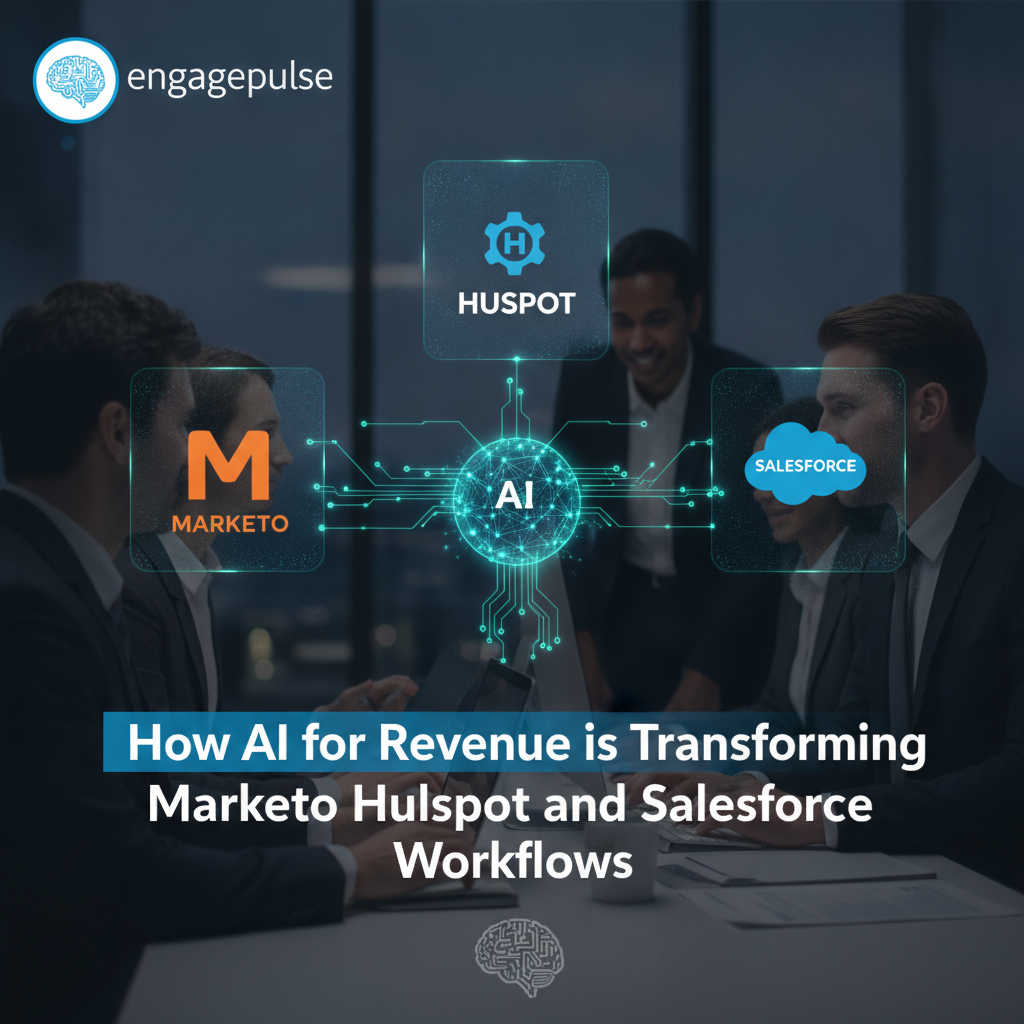
From “AI for Content” to “AI for Revenue”: The Real Opportunity in Modern Marketing Stack Automation
Enterprise teams are moving past basic AI-assisted copy and into systems that can actually change pipeline outcomes. The shift isn’t just “more automation”—it’s creating new value by connecting data, orchestration, and measurement across the stack. In this post, we’ll break down what this means for Marketo, HubSpot, and Salesforce-driven workflows and how it improves lead-to-revenue execution.
Why the AI conversation is changing in marketing tech
Marketing AI used to be framed as a content accelerant: generate emails faster, suggest subject lines, draft landing page text. But the more urgent problem for enterprise organizations is different—growth teams need repeatable execution with measurable lift, not just higher output.
That’s why the “real AI opportunity” is increasingly described as value creation: using AI to guide decisions, automate next-best actions, and optimize cross-channel journeys based on real performance signals. The practical difference is that AI becomes part of revenue operations, not a standalone feature.
The value shift: from isolated campaigns to connected orchestration
In most enterprise setups, marketing automation and CRM live in separate worlds, even when integrated. You might have:
- Marketo for engagement and nurturing
- HubSpot for inbound motion and lifecycle tracking
- Salesforce for pipeline, forecasting, and account context
When AI is bolted onto one system without orchestration across the journey, it tends to optimize local outcomes (like click rate) rather than end-to-end revenue outcomes (like influenced pipeline quality, conversion rates, and sales acceptance).
The new approach focuses on “closed-loop” execution: the system learns from what happens after the message—not only what happened before the conversion.
What “new value” looks like operationally
To make AI-driven marketing automation real, enterprise teams typically need three operational capabilities:
1) Unified intent and engagement data
Instead of treating engagement as a series of events, the marketing stack should convert events into signals tied to accounts, contacts, and opportunities. That includes mapping activity to lifecycle stage, ICP fit, and historical responses.
2) Next-best action tied to business rules
AI doesn’t replace your targeting logic—it should augment it. For example, an “AI recommendation” is most effective when it respects constraints like territorial routing, sales stage requirements, compliance rules, and channel eligibility.
3) Feedback loops back to CRM and reporting
Marketing teams often optimize for the wrong thing because they can’t see downstream outcomes quickly. A closed-loop system pushes performance signals back into Marketo/HubSpot for smarter routing and into Salesforce for accurate pipeline attribution and forecasting.
How this impacts Marketo, HubSpot, and Salesforce workflows
These platforms are no longer just campaign tools—they’re becoming orchestration hubs. Here’s how enterprise teams typically translate the “new AI value” idea into actionable workflows:
Marketo: smarter lifecycle execution
Marketo can be used to operationalize AI-informed scoring and segmentation by feeding it with enhanced engagement signals and firmographic context. The result is more precise nurture paths and fewer misrouted leads.
HubSpot: tighter alignment with sales handoff
With HubSpot, AI-driven recommendations are often most valuable when they influence routing, qualification, and follow-up timing. Better handoffs reduce drop-off and improve the quality of sales conversations.
Salesforce: pipeline truth and account context
Salesforce becomes the system of record for what truly happened. When automation is aligned with CRM state (opportunity stage, meeting outcomes, engagement recency), the marketing engine can adjust faster and more accurately.
Where enterprise automation often breaks—and how to fix it
Even with strong tools, teams run into recurring issues:
- Stale scoring: Models or rules update slowly, so targeting drifts.
- Duplicated logic: Segment rules live in multiple places, causing inconsistency.
- Journey leakage: Leads fall out of flows when CRM statuses change.
- Weak attribution: Downstream outcomes aren’t fed back into marketing execution.
The fix is rarely “use more AI.” It’s about making automation consistent, state-aware, and measurable across the full stack—especially when multiple platforms contribute to the customer journey.
Example + tutorial: Turning AI-informed intent into an account-based nurture (Marketo + Salesforce)
Scenario: An enterprise B2B team wants to prioritize target accounts that show strong engagement, but also ensure that sales receives only qualified leads at the right time.
Goal: Create a closed-loop workflow where engagement signals update lead scoring in Marketo, routing decisions happen reliably, and Salesforce pipeline outcomes feed back into optimization.
Step 1: Define account + contact eligibility rules
In partnership with Sales and RevOps, define what qualifies an account for nurture versus immediate sales outreach. Example rules:
- Account is in ICP list
- Contact has engaged with specific content types (e.g., pricing page, product comparison)
- No open opportunity already exists in Salesforce that matches your criteria
Step 2: Capture engagement signals and convert them into scores
Use Marketo to track meaningful behaviors (not just form fills). Then map those behaviors into a scoring model that reflects both engagement intensity and recency.
Tip: Keep the model explainable. If your team can’t explain why a lead moved up or down in priority, it won’t be trusted—and trust is what makes automation stick.
Step 3: Automate the next-best action based on score + CRM state
Now connect the scoring output to Salesforce opportunity context. For example:
- If score exceeds threshold and account has no active opp: trigger sales task creation in Salesforce
- If score is high but account is mid-cycle: enroll into a tailored nurture in Marketo
- If score drops due to inactivity: reduce touch frequency and adjust messaging
Step 4: Feed outcomes back into execution
Track what happens after outreach—meetings set, opportunities created, deal progression. Then update your Marketo segmentation and nurture logic so the system learns from downstream results, not only engagement behavior.
Step 5: Operationalize and monitor
Finally, measure performance by journey step (not just by campaign). Monitor metrics like:
- Sales acceptance rate after lead routing
- Influenced pipeline quality (stage progression, win rate)
- Time-to-first-touch from engagement event
- Drop-off when CRM status changes
If you want a practical way to implement this across Marketo, HubSpot, and Salesforce, engagepulse.io helps enterprise teams automate and synchronize CRM-driven journeys so your marketing operations can execute with consistency—and improve decisioning over time.
Conclusion
Enterprise marketing teams don’t need AI that generates more assets—they need AI-enabled automation that drives measurable revenue outcomes. The “real opportunity” lies in connecting signals to orchestration, aligning next-best actions with CRM state, and closing the loop with downstream performance. When Marketo, HubSpot, and Salesforce workflows are built for feedback, automation becomes a system for growth, not just a tool for campaigns.

Leave a Reply