

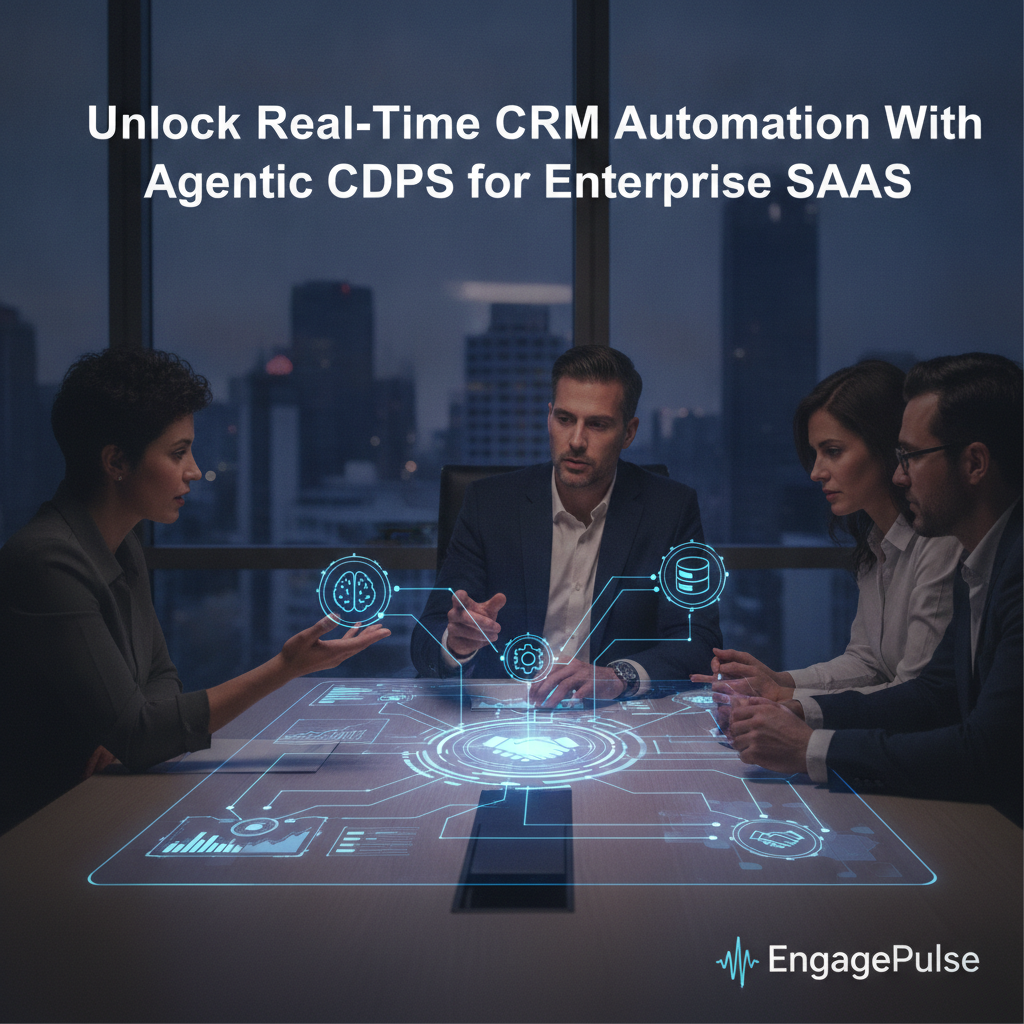
Agentic CDPs Are Here: What Enterprise Marketers Need to Automate Next
Modern buyers don’t just expect personalization—they expect it in real time, across channels, devices, and journeys that change on the fly. The shift toward agentic CDPs is changing how data is unified and how actions are orchestrated. In this post, we’ll break down what agentic CDPs enable, why they matter for enterprise SaaS, and how to operationalize them with CRM-driven automation.
Why “Ready or Not” Is the Right Framing for the Agentic CDP Era
Traditional customer data platforms have often been positioned as the “source of truth.” But enterprise teams know the reality: data quality, identity resolution, and activation are recurring battles—and automation often stops at the point of handoff. Agentic CDPs change the goalpost from storing data to taking action based on that data and the marketer’s intent.
The practical implication is straightforward: instead of building and maintaining endless rule-based workflows, teams can move toward systems that interpret context, evaluate outcomes, and recommend or execute next-best actions—while still honoring governance and permissions.
What Makes an Agentic CDP Different (Beyond “More AI”)
Agentic CDPs aren’t simply “CDPs with AI features.” The difference is operational:
- Closed-loop behavior: Actions (like segmenting, routing, or suppressing) can be evaluated against results, then refined.
- Intent-aware orchestration: The system can take direction from marketing goals, campaign constraints, and journey state—not just static attributes.
- Friction-aware automation: Rather than forcing every change immediately, agentic systems can account for review workflows, latency, compliance, and data freshness.
- Activation-first design: The point isn’t just harmonization; it’s downstream usage across CRM and marketing platforms.
For enterprise SaaS teams, the biggest win is reducing the manual time spent translating “what we know” into “what we do next.”
Where Enterprise Teams Often Get Stuck Today
Even with mature stacks (CRM + marketing automation + analytics), organizations commonly hit the same bottlenecks:
- Identity fragmentation: The same account appears as multiple individuals, or conversely multiple accounts merge.
- Slow time-to-activation: Data updates don’t reach execution channels fast enough for real-time personalization.
- Inconsistent journey logic: Teams create overlapping segments and rules across HubSpot, Marketo, Salesforce, and custom workflows.
- Governance gaps: Auditing who changed what—and why—is harder when logic is distributed across tools.
Agentic CDPs aim to unify the “decision layer” so downstream activation is more consistent and less dependent on manual rule maintenance.
How Agentic CDPs Improve Automation for SaaS (The Real Business Outcomes)
When implemented correctly, agentic CDPs can improve automation in ways that directly impact pipeline and retention:
- Faster lead and account routing: Leads and ABM targets can be matched to the right intent signals and routed to the right team—without waiting for batch processes.
- Better lead scoring with less rework: Scoring models can be updated based on performance feedback, reducing “stale” logic.
- Smarter suppression and pacing: The system can prevent duplicate outreach and enforce frequency caps using unified identity.
- More accurate personalization: Creative and messaging can be selected based on journey stage and observed engagement behavior, not just demographic data.
- Reduced operational overhead: MarketingOps spends less time maintaining fragmented workflows, freeing capacity for experimentation.
Enterprise Governance: The Non-Negotiable Part
Agentic capabilities don’t remove the need for controls—they elevate it. Enterprise teams should ensure the agentic layer supports:
- Role-based permissions for who can approve actions vs. who can only observe recommendations.
- Audit trails that capture what data drove the action and what execution occurred.
- Policy constraints (e.g., compliance suppression rules, region restrictions, partner channel limits).
- Human-in-the-loop options for high-impact actions like pricing offers, deal desk routing, or lifecycle promotions.
In other words: “agentic” should mean guided, not chaotic.
Where EngagePulse Fits: CRM-Driven Activation Without the Chaos
Agentic CDPs are powerful, but they only deliver business value when actions land correctly in your execution systems—typically Salesforce, Marketo, and/or HubSpot. That’s where automation orchestration becomes the differentiator.
With engagepulse.io’s CRM automation approach, enterprise teams can translate unified customer context into consistent activation logic across channels. Instead of building brittle one-off workflows, your CRM becomes the operating system for the journey state—so that any agentic recommendations can be executed in a controlled, trackable, governance-friendly way.
Tutorial: Build an Agentic “Next-Best Action” Loop for Enterprise SaaS Using CRM Automation
This example shows how to implement an agentic-style activation loop for a SaaS company that targets pipeline acceleration without spamming accounts.
Scenario
Your enterprise SaaS has inbound intent signals (webinar attendance, product trial engagement, pricing page visits). The goal: route the account to the right motion (sales-assisted vs. self-serve nurture) and suppress duplicate outreach once the account reaches an active opportunity stage.
Step 1: Define the customer state in CRM
- Create/standardize CRM fields for Lifecycle Stage, Intent Tier, and Opportunity Presence (e.g., “No Opp,” “Opp Created,” “SQL in Progress”).
- Ensure account-to-lead mapping is reliable so the CDP and CRM align on identity.
Step 2: Establish governance rules
- Set suppression policies: if Opportunity Presence = “Opp Created” or higher, stop nurture sequences.
- Define approval thresholds: allow the system to auto-route low-risk leads, but require approval for high-value segments (e.g., top-tier ABM accounts).
Step 3: Activate “intent-to-action” with consistent orchestration
Using engagepulse-style CRM activation logic:
- When a new intent event arrives, update Intent Tier in CRM.
- Trigger the next-best action based on CRM state:
- Sales-assisted if Intent Tier is high AND no active opportunity exists.
- Nurture if Intent Tier is medium AND no active opportunity exists.
- Suppress if an active opportunity exists.
Step 4: Close the loop with performance feedback
- Track outcomes back in CRM (meeting booked, demo completed, opp influenced).
- Periodically refine the rules/thresholds that translate intent signals into routing actions.
Step 5: Execute in Marketo, HubSpot, or Salesforce channels
- Salesforce: route to the correct sales owner and update opportunity-related fields.
- Marketo: run targeted plays for sales-assisted follow-up or nurture tracks where appropriate.
- HubSpot: personalize sequences and lifecycle tagging for self-serve motions.
Result: Even if your agentic CDP suggests or adjusts actions, CRM-based orchestration ensures the final execution is consistent, auditable, and aligned to your lifecycle logic.
Conclusion
Agentic CDPs are reshaping what “customer data” means in enterprise marketing: from storage to action. The opportunity is to improve speed, relevance, and consistency while reducing the operational load of fragmented workflows. Success depends on governance, clean identity alignment, and—most importantly—activation that lands correctly in CRM and execution platforms. With CRM-centric automation, your enterprise SaaS can move from recommendations to measurable pipeline.
If you’d like, tell me your primary stack (Salesforce, Marketo, HubSpot) and the industry you want

Leave a Reply