

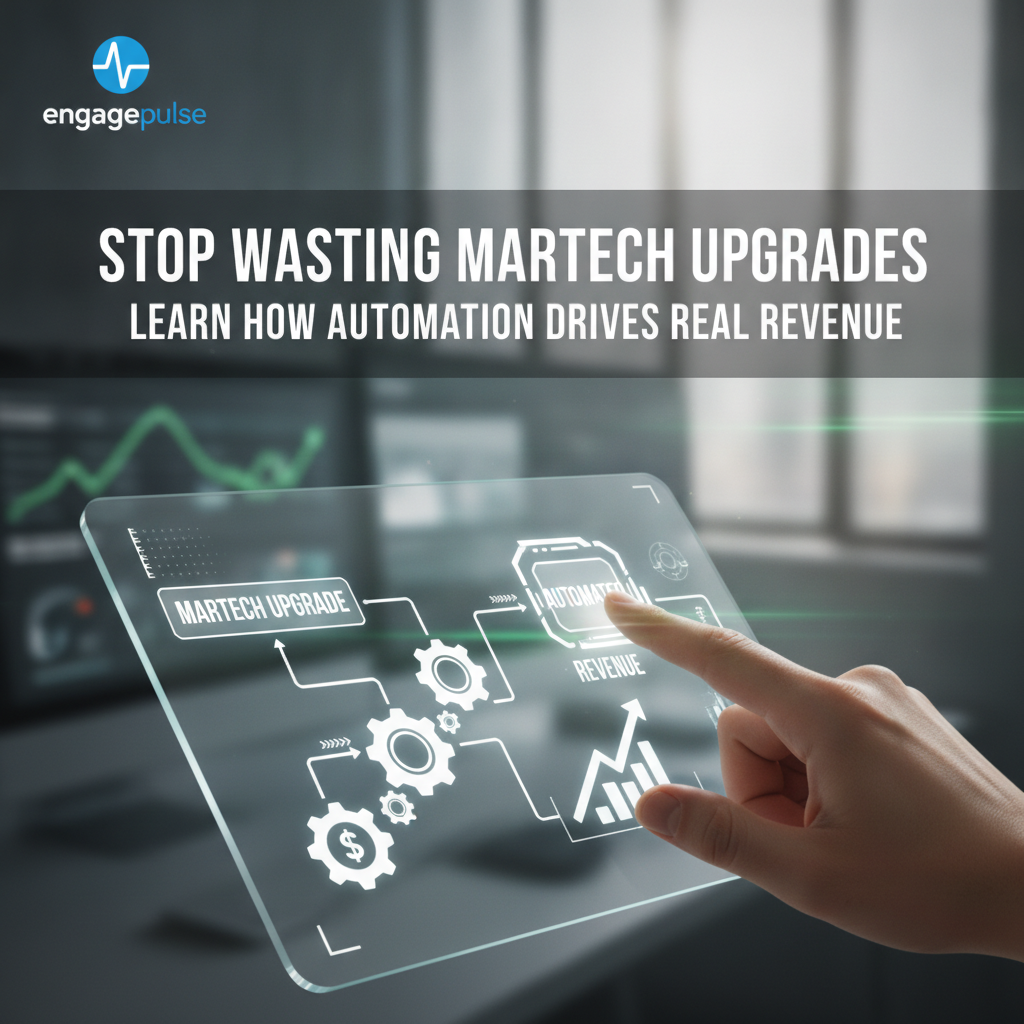
Automation Without Vague Goals: How Enterprise Marketing Teams Can Turn Tech Updates Into Measurable Revenue
Marketing automation is evolving quickly across platforms like Marketo, HubSpot, and Salesforce—and the updates are more powerful than ever. But power alone doesn’t create outcomes. In this post, we’ll connect today’s martech shifts to a practical problem: when objectives are vague, automation can’t optimize. You’ll learn how to reframe goals, instrument funnels, and use CRM-driven workflows to drive measurable growth.
Why “automation” often fails: the goal problem
Many enterprise teams adopt new automation capabilities expecting better performance, then discover that reporting looks “active” but not “effective.” The root cause is frequently not the technology—it’s the objective design. If a goal is framed as something like “improve engagement” or “increase nurture activity,” the system has no clear target state to optimize toward.
Automation excels when it can compare inputs to outputs. That requires goals that are:
- Observable (you can measure them in your CRM/marketing data)
- Time-bound (you know when you’ll evaluate results)
- Attributable (you can connect marketing actions to pipeline and revenue stages)
- Operational (teams can take action based on the measurement)
When martech updates introduce better orchestration, real-time scoring, and smarter segmentation, they amplify whatever structure you’ve already built. Without a disciplined objective layer, teams simply automate uncertainty faster.
What’s changing in marketing automation (and why it matters to enterprises)
Recent platform and ecosystem updates across enterprise-focused marketing tools are trending toward a common theme: moving from “campaign execution” to “journey outcomes.” You’ll typically see improvements in four areas:
- Workflow intelligence: tighter event triggers and more context-aware routing (instead of one-size-fits-all nurturing).
- Better data binding: more reliable sync between marketing platforms and CRM truth, reducing mismatched lead states.
- Enhanced scoring and segmentation: signals are weighted more dynamically, often with guardrails to reduce noise.
- Closed-loop reporting: more visibility into how marketing engagement maps to pipeline movement and deal progression.
For enterprise organizations, these improvements are only valuable if they support a disciplined measurement approach. The opportunity is to redesign objectives so that automation becomes a lever for revenue outcomes, not just activity volume.
How to rewrite objectives so automation can optimize
Instead of starting with “increase engagement,” start with what the business needs the marketing system to change in the CRM. A useful framework is to define a goal as a conversion between funnel states. Then define the instrumentation required to track it.
Step 1: Define the CRM state transitions
Examples of measurable state transitions:
- MQL → SQL within 30 days of a qualifying event
- Trial started → Demo completed within a set engagement window
- Opportunity created → Stage advancement after targeted nurture sequences
Step 2: Map the “event” that should trigger action
Automation becomes powerful when it responds to meaningful events (content consumption patterns, product usage, webinar attendance with intent indicators, pricing page visits for ICP fit, or specific form interactions). The goal is to avoid broad triggers that create endless noisy workflows.
Step 3: Set success metrics and guardrails
For each transition goal, specify:
- Primary metric (e.g., conversion rate from MQL to SQL)
- Secondary metrics (e.g., speed-to-SQL, acceptance rate, pipeline influenced)
- Negative controls (e.g., prevent re-nurturing disqualified accounts, avoid spamming contacts who already converted)
This prevents automation from “optimizing the wrong thing”—a common issue when teams chase engagement at the expense of qualification quality.
Instrumenting the funnel: from lead activity to revenue logic
Enterprise teams typically have plenty of engagement data but incomplete alignment between marketing events and sales outcomes. To close the loop, you need consistent identity resolution and a shared definition of lead/contact/account states.
Key instrumentation practices
- One source of truth for lifecycle: decide whether lifecycle stages live in CRM, marketing automation, or a harmonized layer—and keep them consistent.
- Use consistent campaign and touch attribution fields: so pipeline reporting can connect actions to outcomes.
- Track engagement at the account level: especially for ABM motions where buyer groups matter.
- Align scoring to qualification criteria: scores shouldn’t be “interestingness only”; they should represent likelihood of conversion to a CRM state.
When those practices are in place, the latest automation capabilities become more than features—they become an engine that can route, personalize, and learn based on verified progression signals.
Where CRM automation fits: turning workflows into outcome engines
Automation doesn’t have to be limited to marketing platforms. In enterprise environments, the highest impact is often achieved when marketing workflows collaborate with CRM logic. That’s where CRM-driven orchestration can transform your “journey” into a controllable system.
The objective-to-outcome path usually looks like this:
- Objective definition (state transition + measurable success metric)
- Trigger detection (events that indicate intent or fit)
- Workflow execution (routing, personalization, offers, follow-ups)
- CRM update (lifecycle state changes, ownership rules, enrichment)
- Optimization loop (reports feed back into scoring and sequence decisions)
This approach ensures updates to tools like Marketo, HubSpot, and Salesforce aren’t just adopted—they’re deployed against revenue logic.
Example tutorial: Using Marketo + Salesforce to automate a measurable MQL → SQL transition
Below is a practical example showing how an enterprise team can replace a vague objective with a closed-loop automated workflow. This tutorial focuses on Marketo and Salesforce, but the same logic applies across marketing platforms.
Scenario
Your current goal is phrased as “increase engagement.” Instead, you’ll define a measurable objective:
Increase the conversion rate from MQL to SQL within 30 days for ICP accounts that show specific intent behaviors.
Step 1: Define the trigger event set
In Marketo, identify intent actions that correlate with qualification, such as:
- Attended a product webinar
- Downloaded a pricing or implementation guide
- Visited a key solution page more than a threshold number of times
Step 2: Ensure lifecycle alignment in Salesforce
In Salesforce, confirm the lifecycle stages and required fields used to mark SQL eligibility. Your automation should update or request a change to the lifecycle state based on objective rules—not just activity.
Step 3: Create an orchestration workflow
Build a workflow that:
- Watches for the defined intent behaviors (Marketo trigger)
- Validates ICP fit using account attributes synced from Salesforce
- Routes the lead/contact to the correct nurture path
- Updates CRM fields (e.g., sets a “Sales

Leave a Reply