

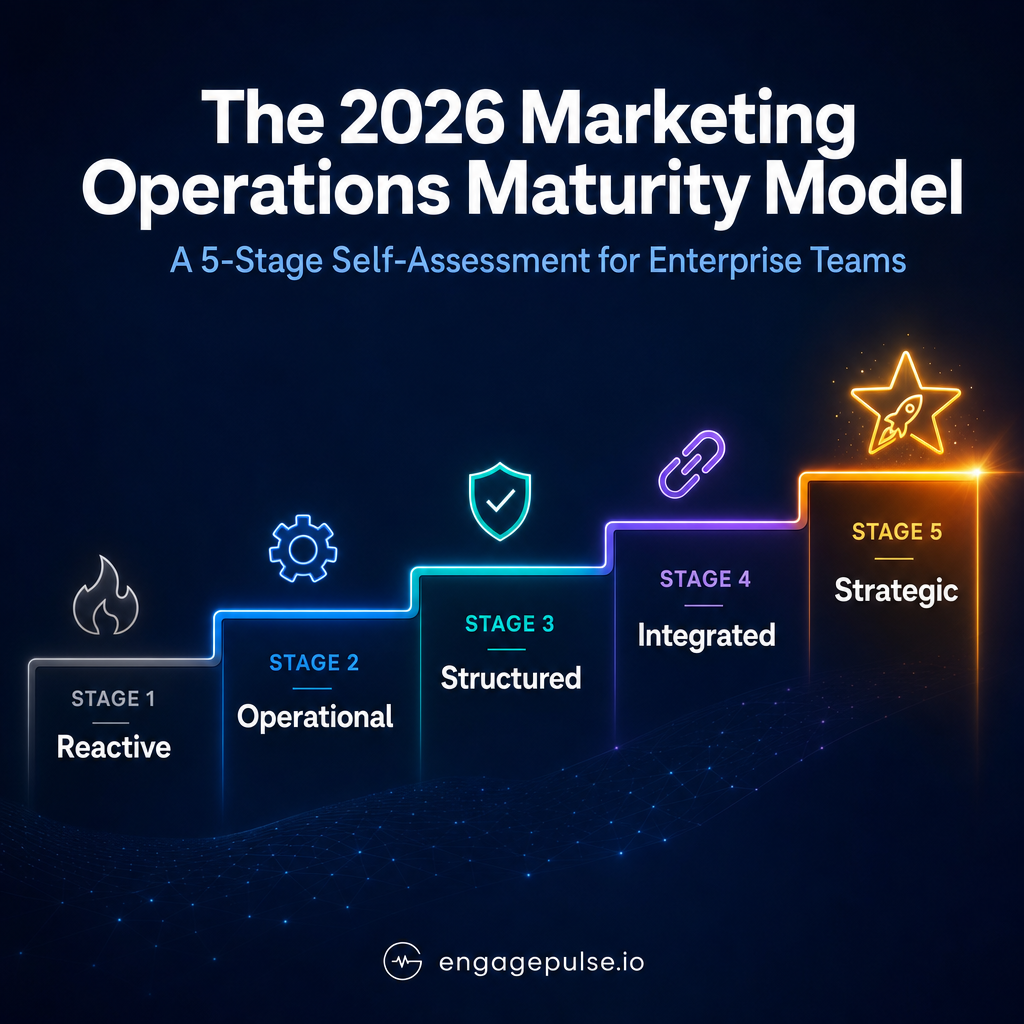
A 5-Stage Self-Assessment for Enterprise Teams
A practical marketing operations maturity model — with 50 self-assessment questions and a 30/60/90 next-move plan for each stage.
By 2026, the marketing operations function has been pulled in two opposite directions at once. On one side, the chiefmartec landscape now tracks more than 14,000 tools and the average enterprise MarTech utilization rate has dropped to around 49%. On the other, 58% of marketing operations teams now report into RevOps rather than Marketing, and AI agents are showing up inside Marketo, HubSpot, and Salesforce Marketing Cloud as first-class actors rather than experiments.
That combination — more sprawl, lower utilization, more revenue accountability, and an entirely new operational substrate in agentic AI — is why a clear marketing operations maturity model matters more than it did three years ago. Enterprise teams need a way to honestly grade where they are, prioritize the next 90 days, and brief leadership without retreating to vague language.
This post lays out the maturity model EngagePulse uses with enterprise B2B SaaS, healthcare, and biotech clients. It includes a 5-stage framework, 50 self-assessment questions (ten per stage), and a recommended next move at each level. By the end you should be able to name your current stage and the specific work that gets you to the next one.
Why a marketing operations maturity model matters now
Most enterprise teams already know they have operational debt. What they usually don’t have is a shared vocabulary for it. Marketing leadership describes the problem one way, Sales describes it another, the CFO describes it as cost. The result is the same conversation every quarter: lots of activity, no agreement on whether the operation is improving.
A maturity model fixes three things:
- It standardizes the diagnosis. Instead of arguing about whether reporting is “broken” or “fine,” a maturity model lets you point to specific, observable conditions — duplicate records above a threshold, undefined MQL-to-SQL conversion, undocumented programs, no scoring governance — and locate yourself.
- It sequences the work. Most teams try to fix everything at once and end up fixing nothing. A maturity model forces sequencing: you cannot get useful attribution without a clean lifecycle, and you cannot scale AI without governance.
- It gives leadership a defensible plan. A board or executive sponsor can absorb “we are at Stage 2 and our 90-day plan moves us to Stage 3” much more easily than a list of tactical tickets.
This particular marketing operations framework is platform-agnostic. It applies whether you are running Marketo, HubSpot, Pardot, Salesforce Marketing Cloud, or Braze. The platform changes the symptoms, not the stages.
The 5 stages of the EngagePulse Marketing Operations Maturity Model
| Stage | Name | Operating mode | RevOps alignment | AI posture |
|---|---|---|---|---|
| 1 | Reactive | Firefighting, undocumented | None | None or shadow |
| 2 | Operational | Some process, fragmented tools | Aware, not aligned | Pilots, no governance |
| 3 | Structured | Frameworks, governance, QA | Aligned definitions | Approved use cases |
| 4 | Integrated | Cross-system lifecycle + automation | RevOps-led | Embedded in workflows |
| 5 | Strategic | AI-augmented, board-level reporting | RevOps + Finance | Agentic, governed |
Move through them in order. Skipping stages produces brittle systems that look mature from the outside and collapse under pressure. The rest of the post walks through each stage with a self-assessment and a first move.
Stage 1 — Reactive
The Reactive stage is the default state of any enterprise team that has grown faster than its operational discipline. Marketo or HubSpot was bought to solve a problem two team leads ago. Campaigns ship because someone heroically rebuilds them every quarter. Reporting answers the questions of whoever is asking the loudest. Nothing is documented because nothing has had time to settle.
Characteristics:
- Campaigns are launched without a defined naming convention or program template
- Lead scoring exists “in someone’s head” or in a spreadsheet from 2022
- There is no shared definition of MQL, SQL, or SAL across Marketing and Sales
- Reporting is rebuilt every executive review
- The Marketo or HubSpot instance has not been audited in 18+ months
- Database hygiene is reactive — clean-ups happen after a sales escalation
- No one can confidently answer “what is currently running in production?”
Self-assessment (count your yeses):
- Do campaigns frequently miss launch dates because of last-minute QA issues?
- Are there multiple naming conventions in use across your instance?
- Have you lost a senior MOps person in the last 18 months without a documented handoff?
- Do you have undocumented Smart Campaigns or Workflows running in production?
- Do Sales and Marketing disagree on the definition of MQL?
- Are duplicate records a recurring complaint from sales?
- Are there integrations whose owners are unclear?
- Has your instance never been formally audited?
- Do reporting numbers vary depending on who pulls them?
- Is the team currently running on someone’s tribal knowledge?
Five or more yeses places you in Stage 1.
Risks: Compounding operational debt, high key-person risk, opportunity loss disguised as “data issues.”
First move: A scoped Marketo audit, HubSpot audit, or MarTech stack audit — depending on the platform — to inventory what is actually running, what is broken, and what is duplicated. The deliverable of a good audit is a prioritized remediation plan, not a sales pitch. (At EngagePulse, this is typically a four-week engagement.)
Stage 2 — Operational
The Operational stage is where most enterprise teams sit. There is real process. Campaigns ship reliably. Someone owns lead scoring. Sales gets leads — most of the time. But the operation is held together by individual heroics rather than by frameworks, and the moment one of those individuals leaves or the company grows past a threshold, things start to break in expensive ways.
Characteristics:
- A working program template exists, but it is not consistently used
- Lead scoring exists and updates, but the model has not been reviewed in 12+ months
- MQL is defined, but the SLA between Marketing and Sales is informal
- Reporting is built but lives in too many places
- Integrations work but are not documented or governed
- Some QA process exists but is informal and inconsistent
- AI tools are being piloted by individuals without governance
Self-assessment:
- Do you have a documented program template that some — but not all — campaigns follow?
- Is your lead scoring model older than 12 months?
- Do you have a written MQL definition but no SLA?
- Are reports duplicated across Marketo/HubSpot, Salesforce, and a BI tool?
- Are integrations functioning but undocumented?
- Does QA depend on a single senior person?
- Are individuals using ChatGPT or Claude in workflows without team standards?
- Are there programs no one is willing to touch because no one remembers why they exist?
- Are migrations or M&A consolidations on the roadmap but not yet planned?
- Do you lack a single dashboard executives trust?
Five or more yeses places you in Stage 2.
Risks: A capable but fragile operation. Sales and Marketing alignment looks fine on paper, but the data underneath does not hold up to CFO scrutiny.
First move: Move from individual practice to operating frameworks. That means a marketing operations playbook — naming conventions, program templates, QA checklist, lead scoring methodology, MQL-to-SQL SLA, integration contracts — written down, reviewed, and adopted. This is where most teams should also formalize AI usage guidelines before tools proliferate further.
Stage 3 — Structured
The Structured stage is the first level where the operation can survive losing a key person without losing capability. Frameworks exist. Governance exists. QA exists. New hires onboard against documented standards. Most enterprise teams that get here describe the change as “we stopped being surprised by our own systems.”
Characteristics:
- A marketing operations playbook is published, versioned, and used in onboarding
- Lead scoring is governed by a quarterly review cycle
- Lifecycle stages and SLAs are agreed in writing across Marketing and Sales
- Campaign QA is enforced by a checklist, not by hope
- The MarTech stack has a documented architecture diagram
- Integrations have named owners and a change-control process
- AI tool usage is approved at the team level with documented use cases
Self-assessment:
- Is your marketing operations playbook published and used in onboarding?
- Is lead scoring reviewed and adjusted on a defined cadence?
- Are lifecycle definitions agreed in writing across Marketing and Sales?
- Is QA enforced via checklist for every campaign?
- Do you have a documented MarTech architecture diagram?
- Do integrations have named owners?
- Are AI tools approved with documented use cases?
- Are SLAs measured and reported?
- Can a new MOps hire ramp in 30 days against your documentation?
- Has the instance been audited within the last 12 months?
Five or more yeses places you in Stage 3.
Risks: Local discipline without global integration. Marketing operations is structured, but it is still a Marketing function, not a revenue function.
First move: Cross the bridge from Marketing operations to revenue operations. That means stitching the marketing lifecycle into the opportunity lifecycle, agreeing on a single definition of pipeline contribution, and getting marketing reporting into the same revenue forecasting motion the sales team uses. This is the stage where a fractional marketing operations or fractional RevOps leader is often the right hire — enough seniority to negotiate cross-functional definitions, without the overhead of a full-time executive.
Stage 4 — Integrated
Stage 4 is where the operation stops being a Marketing thing and becomes a revenue thing. Lifecycle data flows end-to-end. Lead handoffs are observable and enforced. The same numbers show up in the Marketing review, the Sales review, and the CFO review. AI is embedded inside workflows under governance rather than running on the side.
Characteristics:
- A single source of truth for funnel and pipeline data
- Lifecycle stages map cleanly from inquiry through customer
- Lead routing is automated, observable, and SLA-enforced
- Marketing-sourced pipeline and influenced pipeline are agreed metrics
- Reporting is delivered in Power BI marketing dashboards or an equivalent unified layer
- AI is embedded inside campaign workflows (content generation, lead scoring augmentation, intent classification) with governance
- The MOps function reports into RevOps
Self-assessment:
- Do Marketing, Sales, and Finance pull the same pipeline number?
- Is lead routing automated and SLA-enforced?
- Are MQL-to-SQL and SQL-to-Opp conversion rates measured weekly?
- Are marketing-sourced and influenced pipeline both agreed metrics?
- Is reporting unified in a single BI layer?
- Are AI tools embedded in workflows under team-level governance?
- Does MOps report into RevOps?
- Are integrations monitored proactively for drift?
- Are migrations executed without business disruption?
- Are quarterly business reviews driven by MOps-owned data?
Five or more yeses places you in Stage 4.
Risks: A high-performing but expensive operation. The next failure mode is over-tooling, not under-tooling. This is the stage where MarTech consolidation usually pays off more than incremental tool adoption.
First move: A MarTech consolidation review. The goal is to identify the 20% of tools generating 80% of the value, retire the rest, and reallocate the spend into the AI and data infrastructure that powers Stage 5. The 2026 consolidation wave is real — 62% of B2B teams plan to reduce their tool count in the next 12 months, and teams operating with five or fewer core tools report 23% higher marketing-attributed pipeline per headcount.
Stage 5 — Strategic
The Strategic stage is the destination most enterprise teams describe in their three-year plan but few reach. The operation is AI-augmented end-to-end. Agentic workflows handle routine campaign execution, data hygiene, and lead handling. Humans focus on architecture, governance, and strategy. The MOps function reports into a unified RevOps org and presents directly to the board.
Characteristics:
- AI agents execute defined classes of campaigns end-to-end with human review
- Lead lifecycle decisions are partially automated with explainable scoring
- Data hygiene is continuous, not periodic
- A formal AI governance model defines what is allowed, by whom, with what review
- MOps work product is consumed at the executive and board level
- The function is run as a product — with a roadmap, a backlog, and a release process
- The team contributes to enterprise AI strategy, not just executes inside it
Self-assessment:
- Do AI agents execute classes of campaigns end-to-end with human review?
- Is lead scoring partially automated with explainable models?
- Is data hygiene continuous rather than periodic?
- Is there a documented AI governance model?
- Are MOps work products presented at the board level?
- Is the function run with a product roadmap and release cadence?
- Does the team contribute to enterprise AI strategy?
- Are model performance and drift monitored?
- Are AI usage costs reported as a managed line item?
- Is there a defined succession plan for the senior MOps role?
Five or more yeses places you in Stage 5.
Risks: Complacency, governance erosion, and AI-specific failure modes (model drift, hallucinated content reaching customers, attribution opacity). Stage 5 maintenance is its own discipline.
First move: Treat the function as a product. Establish a quarterly roadmap, an explicit governance review for AI workflows, and a formal program for senior MOps succession. This is the stage at which most teams benefit from external advisory — not to execute, but to challenge the architecture.
How to use the self-assessment results
Add up your yeses across all five stages. The lowest stage at which you score five or more is your current operating stage.
Most enterprise teams find they have characteristics from two or three stages simultaneously. That is normal — operational maturity is uneven. The discipline is to refuse to claim a higher stage than your weakest area supports.
A practical sequencing rule:
- Stage 1 → Stage 2: 90 days of audit, cleanup, and basic documentation.
- Stage 2 → Stage 3: 6 months of framework adoption — playbook, governance, QA, lead scoring methodology.
- Stage 3 → Stage 4: 6–12 months of cross-functional integration with Sales and Finance, plus reporting unification.
- Stage 4 → Stage 5: 12+ months of AI architecture, governance, and team operating-model changes.
Skipping is tempting but rarely works. A team at Stage 2 that tries to jump to Stage 4 typically ends up with sophisticated tooling running on top of fragile data — the worst of both worlds.
Frequently asked questions
What is a marketing operations maturity model? A marketing operations maturity model is a staged framework that describes the typical evolution of the MOps function from reactive firefighting through AI-augmented strategic operations. It standardizes diagnosis, sequences improvement work, and gives leadership a defensible plan for investment.
How long does it take to move up a stage? For enterprise teams: 90 days from Stage 1 to Stage 2, six months between Stages 2 and 3, six to twelve months between Stages 3 and 4, and twelve or more months to reach Stage 5. These are operating norms, not guarantees — pace depends on executive sponsorship, headcount, and the state of the underlying data.
Is this model platform-specific? No. The model is platform-agnostic and applies whether you are running Marketo, HubSpot, Pardot, Salesforce Marketing Cloud, or Braze. The platform changes the symptoms, not the stages.
Where does AI fit? AI is treated as a maturity dimension, not a separate axis. Stage 1 has no AI or shadow AI. Stage 2 has pilots. Stage 3 has approved use cases. Stage 4 has embedded AI in workflows. Stage 5 has governed agentic execution. Trying to deploy Stage 5 AI on Stage 2 foundations is the most common failure pattern in 2026.
What is the difference between marketing operations and revenue operations? Marketing operations is the discipline that runs the marketing system — automation platform, lifecycle, campaigns, reporting. Revenue operations is the broader function that aligns marketing, sales, and customer success operations around shared revenue goals. In this model, the transition from Stage 3 to Stage 4 is also the transition from MOps as a Marketing function to MOps as a RevOps function.
How do we get an outside read on our stage? A scoped audit is the fastest way. EngagePulse runs a four-week enterprise audit covering instance health, lifecycle, reporting, governance, and AI readiness, with a written report and a 90-day sequencing plan. Talk to a senior consultant if a third-party assessment would be useful.
Where to go from here
Pick the stage you scored, take the first move recommended, and resist the temptation to skip ahead. The discipline of moving one stage at a time is what separates teams that reach Stage 5 from teams that stay at Stage 2 with more expensive tools.
If you want a copy of the self-assessment as a standalone worksheet, or a benchmarking conversation against other enterprise teams in your industry, book a discovery call with EngagePulse. The first call is scoped to a single question: where are you, and what is the next 90 days.
About the author
Nathaniel Johnson is the founder of EngagePulse and the LinkedIn Marketo Community. He has spent the last 18 years inside enterprise marketing operations, including Marketing Automation Architect work on Microsoft APAC, Marketing Operations & Reporting on Adobe Marketo and Workfront-to-Marketo migration, and AgentForce and MCP-server enablement at Box. EngagePulse partners with enterprise B2B SaaS, healthcare, and biotech organizations on Marketo, HubSpot, Pardot, Salesforce Marketing Cloud, and Braze.
Suggested internal links to add when publishing in WordPress:
- “Marketo audit” / “HubSpot audit” → /services/martech-audit/ (or relevant service page)
- “Marketo consultant” → /marketo-consulting/
- “marketing operations consultant” / “marketing operations consulting” → /services/marketing-operations-consulting/
- “fractional marketing operations” → /services/fractional-mops-leadership/
- “Power BI marketing dashboards” → /services/reporting-and-attribution/
- “MarTech consolidation” / “MarTech stack audit” → /services/martech-consulting/
Suggested Yoast SEO meta for the post:
- Focus keyword:
marketing operations maturity model - SEO title:
Marketing Operations Maturity Model 2026: 5-Stage Self-Assessment(61 chars) - Meta description:
A practical marketing operations maturity model with 50 self-assessment questions and a 30/60/90 plan for enterprise Marketo, HubSpot, and RevOps teams.(154 chars) - Suggested URL slug:
marketing-operations-maturity-model - Featured image alt text:
Marketing Operations Maturity Model — 5 stages for enterprise teams

Leave a Reply