

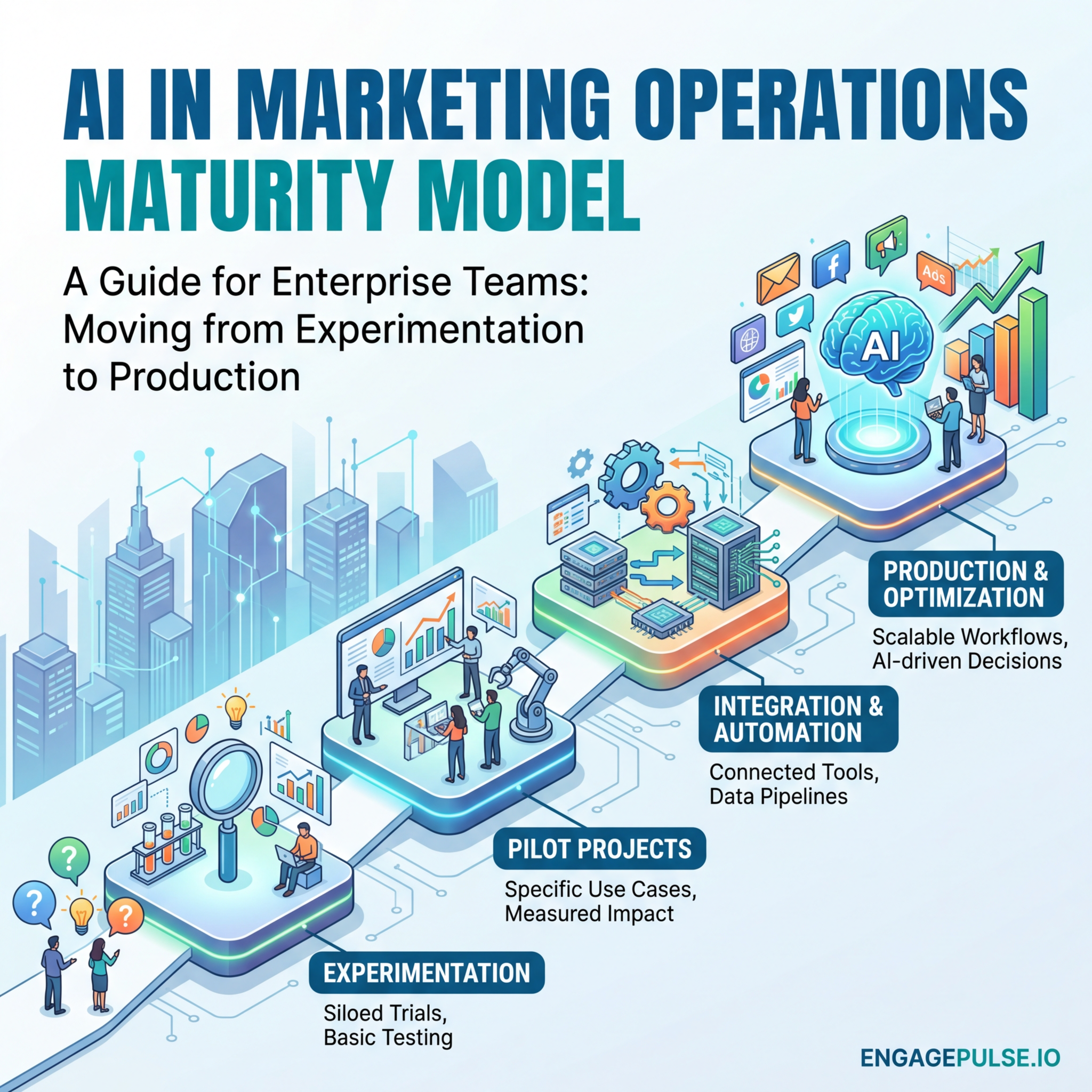
Most enterprise marketing operations teams exist somewhere between “we ran a few pilots” and “AI is core to how we operate.” The gap between those two states is significant — and the path across it is less about selecting the right tools and more about making the right infrastructure decisions in the right sequence.
This post defines a five-stage AI maturity model for MOPs teams and maps out the specific organizational and technical decisions that determine which stage you’re actually in — and what you need to resolve before moving to the next.
Stage 1: Ad hoc experimentation
Characteristics: AI tools are used by individual contributors for personal productivity. ChatGPT for email copy. An AI image tool for a social post. A browser extension that someone found and started using. There is no organizational policy, no governance, no shared tooling, and no visibility into what’s being used or how.
The risk at this stage isn’t that AI is being used — it’s that it’s being used invisibly. Sensitive customer data may be entering third-party AI systems. Brand-inconsistent content may be going out without review. Team members who find AI useful are keeping it to themselves because there’s no framework for sharing it.
What you need before moving forward: a baseline AI policy that addresses data privacy, acceptable use cases, and output review requirements. This doesn’t have to be comprehensive — a one-page document with clear guidance is more valuable at this stage than a 20-page policy that nobody reads.
Stage 2: Structured piloting
Characteristics: The organization has identified specific AI use cases and is running intentional pilots. A content team is testing AI-assisted email copywriting. The MOPs team is evaluating an AI lead scoring vendor. There are designated stakeholders, defined success metrics, and a plan for evaluation.
The most common failure mode at this stage is piloting without a path to production. Teams run a 90-day pilot, see promising results, and then can’t move forward because there’s no decision framework for how a successful pilot becomes an approved production tool. The pilot expires and the team goes back to status quo.
What you need before moving forward: a defined evaluation framework that includes vendor security review criteria, data governance requirements, integration feasibility assessment, and a clear decision protocol for moving from pilot to production.
Stage 3: Isolated production deployment
Characteristics: One or two AI tools are in production use, but they’re operating in silos. An AI content tool that the content team uses but that isn’t integrated into the CMS or campaign workflow. An AI enrichment tool that appends data to records in Salesforce without any feedback loop into Marketo scoring. The tools are delivering value, but they’re not connected to the broader MOPs stack.
This is where most enterprise MOPs teams are currently stuck. They’ve proven that individual tools work. They haven’t built the connective tissue that lets those tools compound value through integration.
What you need before moving forward: integration architecture planning. Map the data flows between your AI tools and your core stack (Marketo, Salesforce, CMS, BI). Identify where AI outputs are currently being consumed manually — copy-pasted into systems rather than flowing automatically — and prioritize the integrations that eliminate those manual handoffs first.
Stage 4: Integrated AI operations
Characteristics: AI tools are integrated into core workflows. Content generated with AI assistance flows directly into campaign approval processes. AI enrichment data syncs automatically into Marketo and updates scoring in real time. AI-generated insights from your analytics layer surface in the dashboards your team uses daily. Human review still happens, but it’s embedded in the workflow rather than bolted on.
At this stage, the organizational challenges shift. You’re no longer fighting for adoption — you’re managing dependency. What happens when an AI vendor goes down and a campaign can’t go out? What are your quality standards for AI-assisted content, and how are they enforced? Who owns the AI tooling budget and the vendor relationships, and how does that interact with IT’s enterprise software governance?
What you need before moving forward: operational resilience planning and quality governance. Document what breaks if each AI tool goes offline. Define your quality standards explicitly — don’t rely on implicit tribal knowledge about what “good” AI output looks like. Build a review cadence for your AI vendor relationships, because the tools are evolving faster than most annual contract cycles.
Stage 5: AI-native MOPs infrastructure
Characteristics: AI is not a layer on top of your MOPs stack — it’s embedded in the foundation. Scoring models are ML-based and retrain automatically on new behavioral data. Content personalization at the campaign level is driven by AI models, not by manually configured smart lists. Attribution analysis surfaces insights proactively rather than waiting for someone to build a report. The MOPs team’s job has shifted from manual execution toward model oversight, quality governance, and strategic interpretation.
Very few enterprise MOPs organizations are at Stage 5 today. The ones that are got there by making the right foundational decisions at Stages 1 through 4 — not by leaping from experimentation directly to AI-native operations.
Honest assessment: where are most enterprise MOPs teams?
Based on the pattern of inquiries and assessments we run, the majority of enterprise MOPs teams are at Stage 2 or Stage 3 — with most of the Stage 3 teams having the ambition of Stage 4 but missing the integration infrastructure to get there.
The most important insight from this model isn’t the destination — it’s that each stage requires a different primary constraint to be resolved before progress is possible. At Stage 1, the constraint is policy. At Stage 2, it’s evaluation infrastructure. At Stage 3, it’s integration architecture. At Stage 4, it’s operational resilience. Trying to solve the wrong constraint for your current stage is how MOPs teams spend enormous energy on AI initiatives that don’t compound into capability.
Assess your stage honestly. Solve the right constraint for where you actually are. Then move.

Leave a Reply