 (909) 474-2386
 Suwanee, GA

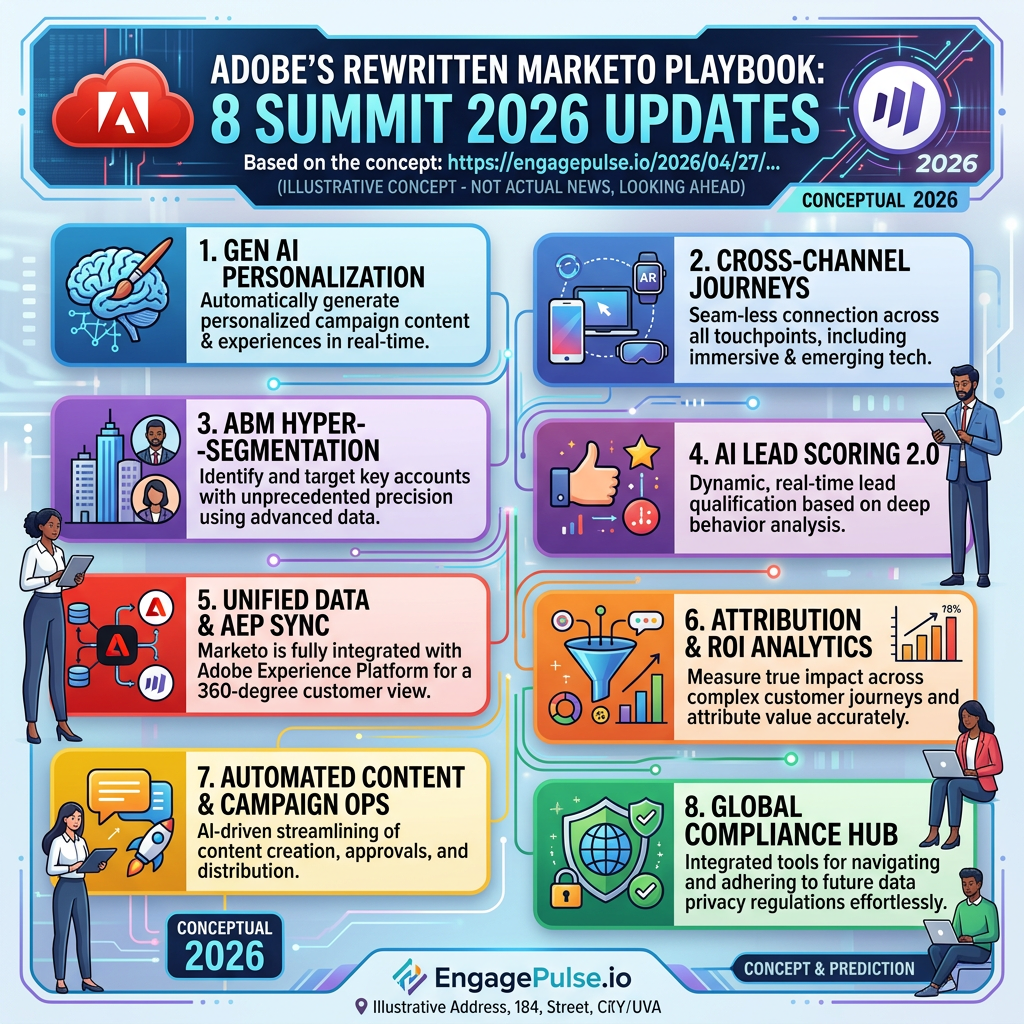
Marketo’s Drastic Change and the Birth of the Adobe MCP Server
If you blinked during Adobe Summit 2026, you missed Adobe quietly turning Marketo Engage into a different product. Not a refresh. Not a UI polish. A full repositioning from a campaign execution platform into an AI-native, agent-driven marketing operations stack.
I’ve been in the Marketo ecosystem for over a decade — building lifecycle frameworks, migrating instances, integrating tech stacks for everyone from Microsoft to Workday to Dropbox. So when Adobe drops 12+ announcements that touch the platform I’ve built my career on, I pay attention. And so should you.
Here’s the truth most recap blogs are going to bury: the moves Adobe made at Summit 2026 are going to separate the marketing operators who get paid from the ones who get replaced. Not because AI is taking jobs — it’s not. But because the people who learn how to operate this new agentic stack are about to become 10x more valuable, and the people who don’t will be running 2019 plays in a 2026 world.
Let’s break down the eight things you actually need to know.
1. Adobe Experience Cloud Is Now Adobe CX Enterprise
Yes, the umbrella brand changed. But this isn’t just marketing department theater.
Adobe is rebranding the entire stack as Adobe CX Enterprise, organized around three pillars: Brand Visibility, Customer Engagement, and Content Supply Chain. Sitting underneath is a new Adobe AI Platform with two intelligence systems — Brand Intelligence (governs brand consistency across AI channels) and the CX Engagement Intelligence System (handles audience, channel, and journey optimization).
Why this matters for Marketo users: Marketo isn’t being deprecated, but it is becoming a layer in a bigger AI-orchestrated platform rather than the standalone tool you’ve known. The shift is from “tool-centric marketing software” to “goal-oriented, AI-first workflows.” Translation: instead of clicking through Marketo to build a program, you’ll be telling an agent what outcome you want and watching it assemble the program.
If you’re a Marketo admin, your job is shifting from operator to orchestrator. Get ahead of it.
2. The Marketo MCP Server — This One Changes Everything
This is the big one. If you read nothing else, read this section.
Adobe is releasing a native Model Context Protocol (MCP) server for Marketo Engage. In plain English: you can now plug Claude, Copilot, Cursor, ChatGPT Enterprise, or any MCP-compatible AI tool directly into your Marketo instance through secure authentication.
The Marketo MCP server exposes 100+ operations across forms, programs, smart campaigns, leads, emails, snippets, lists, and folders. It’s hosted by Adobe (no server-side software to deploy), it’s multi-tenant, and credentials are passed per-request — they don’t get stored or cached.
Here’s what you can actually do with this:
- “Hey Claude, audit my Marketo instance for unused programs older than 18 months and give me a deletion shortlist.” Done.
- “Build me a smart list of leads with engagement scores above 70 who haven’t been touched in 30 days.” Done.
- “Generate the email copy for the Q3 webinar nurture, then create the program structure in Marketo.” Done.
- “Diagnose why MQL conversions dropped 12% last week.” Done.
I’ve spent years writing custom Velocity scripts and webhook integrations to get Marketo to do half of what an AI agent can now do conversationally. The MCP server collapses weeks of integration work into a configuration step.
Reality check: The MCP server lands in a space where Inflection.io, Zapier, and CData already offered Marketo MCP servers. Adobe was actually behind the market here, which tells you everything about how fast enterprise demand has been moving for agentic marketing automation.
If you’re not learning how to operate AI agents on top of your MarTech stack right now, you are already late.
3. Marketo Now Has Purpose-Built AI Agents
Beyond letting external AI tools call into Marketo, Adobe is building a roster of purpose-built agents native to the platform. These handle five operational categories that drain the average MOps team’s bandwidth:
- Program creation — agents that build out programs based on natural language instructions
- Campaign validation — automated QA on smart lists, flow logic, and recipient targeting
- Smart list building — translate intent into actual segmentation rules
- Lead import enrichment — clean and append data on inbound records
- Data normalization — standardize fields like job titles, company names, and phone numbers in real time
That last one deserves special attention. Callable agents can run via webhooks inside Smart Campaign flow steps, which means a lead can hit your form, get cleaned, normalized, scored, and routed before the record ever lands in Salesforce. If you’ve ever spent a quarter cleaning up “Sr Mgr, Marketing” vs “Senior Manager Marketing” vs “snr. mngr – mkt” duplicates, you know why this is a big deal.
I built data hygiene programs at Dropbox by integrating NeverBounce, RingLead, and a stack of operational programs to catch bad data. With agentic normalization built into the campaign flow, a lot of that custom plumbing becomes legacy.
4. The New Conversational Marketo UI
Adobe is layering a chat panel as the primary interface for Marketo Engage. Instead of clicking through 17 menus to build a smart campaign, you’ll be able to type “build me a re-engagement campaign for leads who opened the last newsletter but didn’t click” and watch the platform assemble it.
Pair this with the new AI Assistant for product knowledge — an in-app help system where users can ask “How do I build a nurture campaign?” or “How do I create a Smart List?” and get instant step-by-step instructions inside the platform. No more digging through Experience League. No more onboarding new admins by walking them through 40 screenshots.
For agencies and consultants, this is going to compress the time it takes to onboard a new Marketo user from weeks to days. For in-house teams, it means new hires become productive faster. For me, it means the questions I get in the Marketo Community on LinkedIn are about to look very different.
5. AJO B2B Edition Splits Into Prime and Ultimate
Adobe Journey Optimizer B2B Edition is being restructured into two tiers, and this directly affects Marketo’s positioning:
- AJO B2B Edition Prime (available Q2 2026): a new lower-entry-point tier that runs on Marketo Engage data
- AJO B2B Edition Ultimate: the existing product, now requiring Real-Time CDP B2B
This creates a clear maturity ladder: Marketo Engage → AJO B2B Prime → AJO B2B Ultimate. If you’re a Marketo customer who has been priced out of AJO B2B’s full edition, Prime is your on-ramp.
Also worth noting: AJO B2B is getting Semantic AI Decisioning for next-journey and next-step recommendations. This is the kind of capability that used to require a custom data science layer. Now it’s built in.
6. Sales Qualifier and the Account Qualification Agent
Adobe rolled out the Sales Qualifier — an AI-first add-on for AJO B2B that’s built specifically for Business Development Reps. It includes the Account Qualification Agent which automates prospect qualification, outreach, and buyer engagement workflows across channels.
The pitch is simple: it reduces manual BDR load and accelerates pipeline velocity. The reality is that this category — AI SDRs and qualification agents — has been one of the hottest AI investment areas of the last 18 months. Adobe is now playing here directly, with browser and email plugins that surface business intelligence inside Salesforce, Microsoft Dynamics, and Outlook.
If you run a B2B operation, the question isn’t whether you’ll deploy AI for outbound qualification. It’s whether you build it custom, buy it from a startup, or take what Adobe is bundling.
7. The New Email Designer With Built-In GenAI
The Marketo Email Designer is getting a major glow-up. The new version brings:
- Built-in generative AI for drafting and refining email content directly in the editor
- Manage Brands (beta) — generate email content based on your organization’s specific copywriting guidelines
- Quick actions for emails, templates, and fragments (duplicate, delete, move, draft management)
- Centralized styling and reusable content for cross-campaign consistency
- Linked assets so that updating one fragment cascades across every email that uses it
For anyone who has spent a Friday afternoon manually updating 30 emails because legal changed a disclaimer, this is the kind of feature that buys back your weekend.
8. The Deprecations You Cannot Ignore
While everyone is celebrating the new toys, there are some quiet deprecations buried in the release notes that will absolutely break your instance if you’re not ready:
- SEO Feature Deprecation — Marketo Engage deprecated the Search Engine Optimization feature on March 31, 2026. If you used it, you needed to export your data.
- SOAP API End of Life — Support for the Marketo SOAP API ends July 31, 2026. If any of your legacy integrations still run on SOAP, get them migrated to REST now.
- REST API
access_tokenQuery Parameter Deprecation — The query parameter authentication method ends July 31, 2026. Move to header-based authentication. - Merge Leads API Limit — Calls with more than 25 IDs in the
leadIdsparameter now return a 1080 error. Split your batch jobs accordingly.
If you’re an admin or consultant, audit your custom integrations this week. I’ve seen instances where companies didn’t realize they had legacy SOAP integrations until everything broke at the same time. Don’t be that company.
What This Actually Means for Your Career
Here’s where I’m going to be honest with you in a way most MarTech recap posts won’t.
The skills that paid me well for the last 15 years — building Velocity tokens, hand-coding email templates, writing webhook integrations, architecting lead lifecycle frameworks — those skills aren’t going away. But they’re getting commoditized fast. AI agents can now do 70% of what a junior MOps person does, in seconds, for pennies.
The marketers who win the next three years are the ones who stop competing with AI on execution and start operating above it. That means:
- Learning to design and orchestrate multi-agent workflows. You’re not building campaigns anymore — you’re building systems that build campaigns.
- Mastering MCP and the agent-to-agent connectivity layer. Marketo’s MCP server is one of dozens you’ll be working with. The future MOps person manages a constellation of AI agents across their stack.
- Doubling down on strategy, governance, and lifecycle architecture. AI can build a smart campaign in 30 seconds. AI cannot tell you which lifecycle model fits your sales motion. That’s still you.
- Becoming fluent in prompt engineering and agent design. This is the new “knowing CSS.” It’s a baseline skill for anyone touching marketing tech.
If you’re a marketing operator reading this and you’ve been waiting for a sign that it’s time to skill up on AI, this is the sign.
The Bottom Line
Adobe Summit 2026 wasn’t a feature dump. It was a strategic repositioning. Marketo is no longer just a marketing automation tool — it’s becoming a programmable surface for AI agents, with a conversational UI sitting on top, deep integration with Claude and Copilot via MCP, and a full B2B journey orchestration stack layered above it.
The platform got a lot more powerful. It also got a lot more demanding of the people who operate it.
The MOps teams that adapt will run leaner, faster, and more strategic operations than ever. The ones that don’t will spend the next 18 months wondering why their workloads keep getting handed to AI.
I know which side I want you on.
If this hit, here’s what to do next:
🔥 Follow me on LinkedIn, YouTube, and Facebook for daily AI + automation breakdowns aimed at marketers who want to stay ahead of the curve.
🎯 Want to go deeper? Join my Skool community where I walk through real-world AI agent builds, Marketo MCP workflows, and the exact playbooks I use to help my clients scale. We’re building the operators who don’t just survive the AI shift — we lead it.
The next 18 months are going to make some careers and end others. Make sure yours is on the right list.
— Nathan That Digital Strategist

Leave a Reply